#72: Is everyone getting raptured without me?
Death By Consumption
9/16/25 - 9/22/25
If you're reading this, congrats on being one of The Leftovers. In the surest sign yet that our entire society has a terminal case of peasant brain, people went full-blown hysteria mode this weekend and convinced themselves the actual Rapture was happening today. Did it? You tell me! (I'm writing this on Monday, just in case I do get Raptured — can't let the Rapture get in the way of emails!) I, personally, love that a solid 40% of our society are experiencing full-blown religious psychosis at all times. Everyone is a preacher and a shaman now, speaking in tongues while asking you to like and subscribe. I'm hoping I don't get Raptured, though, mostly because I'm really looking forward to Criterion adding a bunch of classic horror films next month. There's too much to consume still, down here!
This week: I was utterly transformed by Julio Torres's one-man show, I saw Darren Aronofsky's mediocre new movie, I went to a friend's short film premiere, I enjoyed yet another takedown of AI, and I learned that author Gary Indiana saw all this shit coming way back in the 90s.
Color Theories — at Performance Space New York
Despite finding most one-man-shows annoying, I’ve become an unintentional semi-regular one-man-show guy. Andrew Scott’s Vanya was a little bit good, a little bit embarrassing. Sarah Snook’s Picture of Dorian Gray was an unbelievable feat. Josh Sharp’s ta-da! was funny but kind of just stand-up comedy with a slideshow. But Julio Torres’s Color Theories is possibly the best one-man-show I’ve ever seen.
On a minimalist set that’s a little bit like if Salvador Dalí was locked in an insane asylum on a spaceship, the show is simply Julio Torres explaining his theories about colors. “This is not an off-Broadway show,” he tell us at the start; instead he says it’s a preview of what will soon be mandatory classes in all public schools in New York City. How? “I donated $130 to the Zohran Mamdani campaign, making me one of his largest donors. The man is my puppet.”
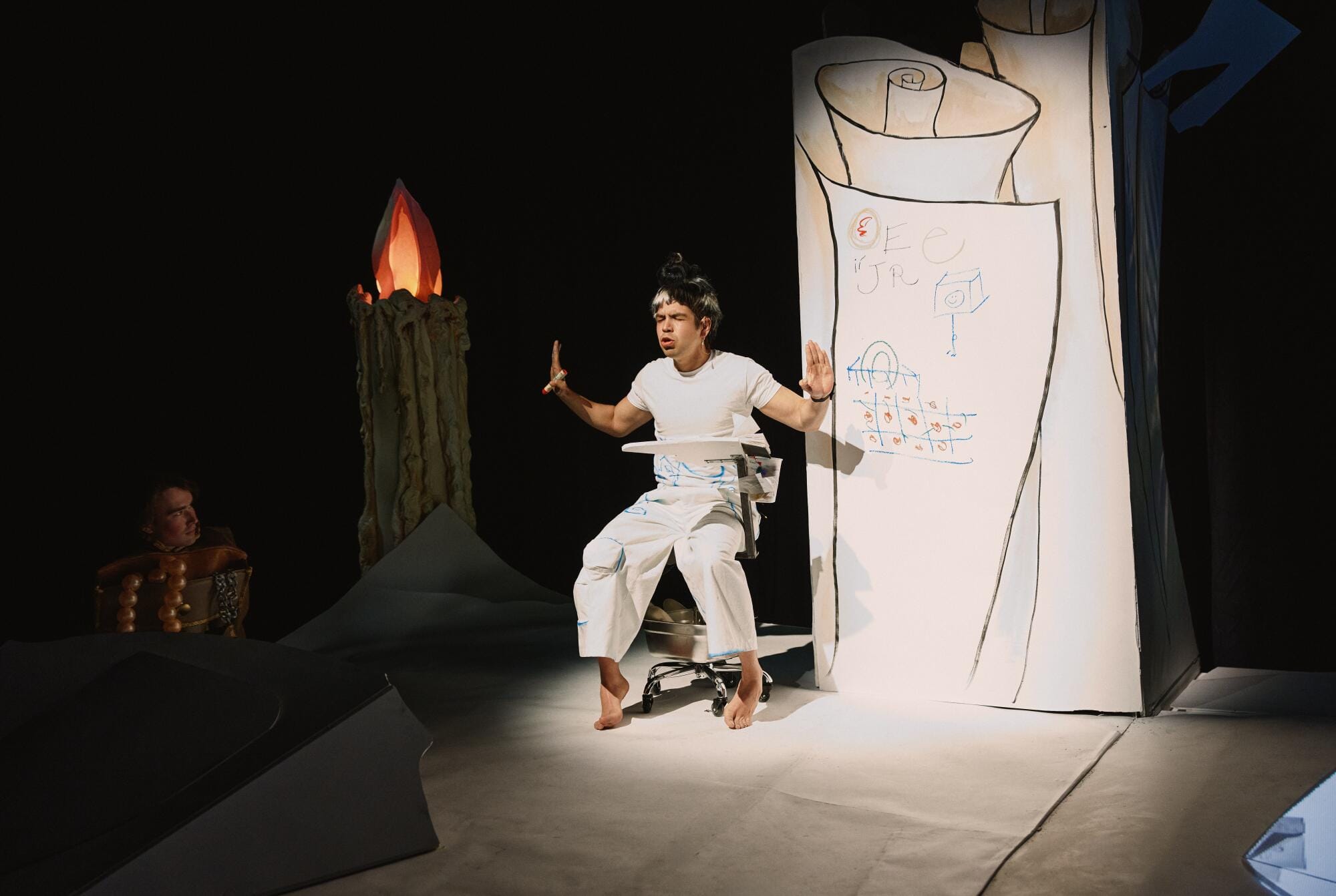
His theories on colors — which start, naturally, with a deep analysis of the colors and font choices used in Ellen Degeneres’s talk show logo — are initially insane but, over time, make perfect sense. Red is, of course, aggression or surprise. Green is the sound of rainfall, or ducks swimming in a line. Yellow is the "platonic ideal of childhood." So orange, as the midpoint between yellow (childlike wonder) and red (rage), is Ellen Degeneres, but also Dwayne “The Rock” Johnson. (“We like our male celebrities to be orange because they’re exciting but not threatening.”) Blue is logic, which — when you add the deliberate obfuscation of black — becomes navy blue, Julio’s most hated color. Navy blue is authority and oppression. And navy blue is at its most evil when it's hidden behind a "beige mask" — the way our country hides its evils and abuses behind soft language and happy corporate logos.
See? The connections Julio makes are absurd on the surface, but upon reflection carry the truth of genuine revelations. In a matter of, like, 3 minutes, he used his color theories to connect the traffic patterns in Hanoi, to the video-return penalties at Blockbuster, to war crimes, to Real Housewives fighting at a sushi event. It was nonsense that made all the sense in the world. I could have sat there for 4 straight hours and been completely enthralled. He warned us up front we wouldn’t have time for every color (“if your favorite color is mentioned, please celebrate quietly, in case we do not get to the favorite colors of the people next to you”), but I wouldn’t complain if this were turned into a 100-hour performance piece in which Julio does get to every color. I have a desperate need to know his thoughts on teal!
To keep him on track from his frequent, hilarious digressions, Julio has a blue (of course) robot named Bibo who pops out of a gigantic clock to yell at him. By the end of the show, the audience would die for Bibo, even though we're also kind of annoyed at him for cutting short some of Julio's bits — my favorite was a long story in which he described the process of transferring your data to a new iPhone as "casting the spell that moves your phone from its old body into its new, supple body," and what happens when it inevitably fails halfway: "I now have two phones that are convinced they are my one, true phone. ... I have no money. I can't call a friend. I have fallen through the crevices of society."
The show is indescribably brilliant, and clearly the work of a singular brain. There is no one on the planet who could have made this show other than Julio Torres, and spending 80 minutes in his mind is a gift. It felt transcendent, and has genuinely reshaped the way I view the world (I found myself instinctually side-eyeing a friend's navy blue bike recently... I do not trust it). I don't know if he's going to extend the show, but I hope he films it and one of our godless streaming platforms picks it up, because a show this brilliant actually should be mandatory viewing.
Caught Stealing (2025) — at Nitehawk Prospect Park
This felt like Darren Aronofsky doing a Guy Ritchie film, but without the brilliance of typical Aronofskys or the frenetic charm of typical Ritchies. It's just kind of... a movie. It's set in the 90s and feels like a 90s movie in every way — the characters, the story beats, the humor. In that way, it's a bit refreshing, as a late-summer big, dumb movie, but it leaves no lasting impressions. Austin Butler and Zoë Kravitz are both charming and sexy together (but they have nothing on the sexual chemistry Austin Butler has with Bad Bunny). This movie felt like a throwback in every way — it's a real New York movie, the kind we rarely get anymore, with the camera lovingly embracing the grit and chaos of the subways, bodegas, and weirdly aggressive Hasids. It's a bit pointless and brainless and not as charming as it thinks it is, but it's fine, okay? It's fine. Like the many 90s and early-2000s films it is paying homage to, it is probably destined to spend the rest of its existence buried in an in-flight entertainment system.
Conejita (2025) — at some random Bushwick loft
My friend Steven premiered his short film last weekend, giving me my first reason to go to Bushwick in, like, at least a year. I had been out all day and didn't go home to change, so I was the only person shamefully wearing bright blue at a party with a dress code that called for black and white. I suffered through more than a few stinkeyes from too-cool-for-school Gen Z-ers, but thankfully Steven is too much of a gentleman to care that I was blatantly snubbing his dress code, and, anyway, I noticed a couple girls who were dressed exactly like extras from Pirates of the Caribbean 3, so I quickly got over my insecurity about wearing the wrong colors. (3 glasses of wine also helped me get over it.)
Anyway, it's so heartwarming and exciting to see a friend release something they worked so hard on and care so much about, and Conejita, which Steven filmed in Argentina, shows he has a natural eye. There are beautiful shots in here! Now, am I smart enough to completely understand the message of the film? Of course not. Steven, you see, is a film buff — always eager to talk your ear off about some 1960s Italian or French cinema classic you've never even heard of — so anything he made was always going to be too layered and deep for a simpleton like me. (3 glasses of wine also probably didn't help my intelligence level.) Congrats to Steven, and you can watch the film for yourself here!
"Large Language Muddle" by The Editors — at n+1
There have been a million "AI sucks actually" articles written already, but this one takes a much-needed different approach, by focusing its ire on a specific, endemic type of reporting, in which writers grapple with their experiences with AI (on dating apps, on homework, on writing itself, etc.). It's an obnoxious genre that I've quickly grown tired of, and this essay skewers all the cliches you'll find in these many many many articles the media loves pushing out — the quick nod to environmental concerns, the moment when the writer tries AI for themselves and is surprised and slightly scared, and the inevitable conclusion that AI can't replace humans because we make adorable mistakes. Boring! And yet this shit is all over the place (there's a new one right now on the New Yorker's homepage, about what happens to doctors after AI — pretty sure we'll need doctors for a while, guys!).
The n+1 overly academic style can sometimes be grating to read (no other publication would have the balls or arrogance to start a paragraph, "In the face of a monolith-in-the-veldt-level era-heralder" ....... girl, what?????), but the essay builds to a grand rallying cry that we can and should resist incorporating AI "creativity" into our everyday life, not only for moral or environmental or economic reasons, but mostly because this shit sucks and is bad and ugly!
Stigmatization is a powerful force, and disgust and shame are among our greatest tools. Put plainly, you should feel bad for using AI. (The broad embrace of the term slop is a heartening sign of a nascent constituency for machine denial.) These systems haven’t worked well for very long, and consensus about their use remains far from settled. That’s why so much writing about AI writing sounds the way it does — nervous, uneven, ambivalent about the new regime’s utility — and it means there’s still time to disenchant AI, provincialize it, make it uncompelling and uncool.
Exactly! I have yet to read a single sentence or see a single image or video produced by AI that feel compelling or even worth my attention. It's genuinely boring, uncreative, low-quality slop, and I'm tired of everyone acting like it can say stuff that's worthwhile. I genuinely find the things said by a Ouija board more interesting. As far as I'm concerned, the only people who should have access to AI are scientists and meteorologists. The rest of it is trash!
Resentment, by Gary Indiana (1997) — paperback
This is my first Gary Indiana book, and I could not have picked a more apt time to dive into his work. A savage chronicler of what he defined as America's "depraved indifference" at the end of the 20th century, he more or less saw all this shit coming. Resentment, set in LA around a loosely fictionalized version of the Menendez Brothers' trial, follows a cast of miserable characters surrounding Seth, a resentful and semi-spiraling NY writer sent to LA to write a profile of a famous actor about to play a gay man with AIDS in a movie, who gets sidelined by his obsession with the trial.
The cast of characters are mostly gay men, miserable and self-absorbed, as the action unfolds in a series of endless run-on sentences — a style that typically annoys me, but Gary's writing is so playful and lyrical that the words just carry you along. The narrator has gorgeous disdain for practically every character: two obnoxious gays are "social climbing with the easy agility of chimpanzees scaling a baobab tree." A woman wearing an ostentatious, all-red outfit is "dressed to panic livestock." I haven't genuinely laughed at a novel in ages, but Gary Indiana had me loling on the subway like some sort of maniac.
The book is, at times, nauseating; towards the end of the book, one of the characters is revealed as a serial killer, by literally fisting a man to death, in a scene that genuinely left me lightheaded. But so many gay writers these days are softbois who write poetry-adjacent prose full of sexless queer longing in books called, like, All The Summers We Never Had or whatever. So it's refreshing to read Gary Indiana, a certified BITCH, lacerating every part of our culture.
Against the background of the forced national mourning of Charlie Kirk — the apotheosis of the cynical and hollow evangelical takeover of American life that started in earnest way back in the 80s — reading Gary Indiana was a necessary balm, and a welcome reminder that the most dangerous attitude any of us can have is apathy, because the evil men trying to kill us all are counting on us not caring what happens to others. We need more rude bitches like Gary Indiana, telling these people to fuck off.