
#92: Here comes The Bride!, unfortunately
LOCK HER (Maggie Gyllenhaal) UP

Death by Consumption
3/3/26 - 3/9/26
It’s a beautiful 70+ degree day in NYC, here at the beginning of the end of the world, so you’ll have to forgive me for skipping right to the main drama of this week’s email because I desperately need to go outside before we’re plunged back into winter. And I have a lot to say in this email, because a movie really made me mad this week!!!!
This week: I suffered through Maggie Gyllenhaal’s big flop, and I watched three movies about people having affairs, which is a strange coincidence, I swear I’m not admitting to anything here with those choices, Justin. I also, coincidentally, started reading Pynchon during the beginning of World War III, which was a bad choice.
The Bride! (2026) — in IMAX at AMC Kip’s Bay
Maggie Gyllenhaal’s The Bride! is a two-hour movie that’s two hours too long, an infuriating, exhausting, excruciating film that, like Frankenstein’s monster, should have never been created. The Bride! has the aesthetics of a teenager throwing a tantrum in a Hot Topic, and the emotional intelligence and political depth of Hakeem Jeffries. This movie is so bad it actually made me switch sides in the eternal Maggie Gyllenhaal vs. Park Slope Co-op war; maybe if she had worked her required shifts at the co-op, she wouldn’t have had the time to make this monstrosity. They were trying to save us all along!
The nicest thing I can say about The Bride! is that in comparison to Guillermo del Toro’s boring (and bafflingly Oscar-nominated) Frankenstein, at least I felt something while watching it. The problem is that “something” I felt was a combination of exhaustion, annoyance, and resentment. The longer this movie went on, the more upset I got that I was still watching. Is it a good sign for a film if you get excited every time the main characters have guns pointed at them, because maybe they’ll die this time and you can finally go home?
One of the many, many problems with this movie is its incoherent plot. Let me try to summarize: the year is 1936, and Oscar winner Christian Bale is Frankenstein’s monster, who has been wandering the planet for over 100 years in search of pussy. Yes: this entire movie is kicked into motion because Frankenstein is horny. So Frankenstein (or “Frank”) enlists Annette Benning, a lady mad scientist (there are several moments in this movie in which ham-fisted male characters are like, “But women can’t be [occupation]! Whaaaaa??!!” and it’s always very funny) to dig up a dead woman and make him a bride so he can finally lose his virginity. The body they get belongs to future Oscar winner Jessie Buckley, who plays a New York-accented flapper who dies after becoming briefly possessed by the ghost of Mary Shelley, author of the original Frankenstein novel. I’m sorry to say I am not making any of this up. There’s also a whole separate thing going on with the mafia, and Peter Sarsgaard and Penélope Cruz playing a pointless pair of detectives, but none of that really matters so why get into it?
The Mary Shelley of it all is the most baffling choice in a movie full of baffling choices — the only reason we’re given as to why Mary Shelley possesses Jessie Buckley (Mary is also played by Jessie, in a series of excruciating scenes in which she basically tells knock knock jokes straight to camera while dressed like Cole Escola in Oh, Mary!) is because she wants to get revenge on men on behalf of women, I guess? We’ll get into the movie’s take on feminism a bit later, but the politics of this movie are the equivalent of those “if Hillary had won we’d all be at brunch” signs. (It’s actually so embarrassing I coincidentally saw this movie on International Women’s Day, now that I think about it. I am a MALE ALLY.)
Anyway, this is all to say: when Jessie Buckley is reincarnated as “The Bride of Frankenstein,” Mary Shelley’s possessed spirit is, I guess, reincarnated inside of her, too? As a result, Jessie Buckley spends the entire movie alternating between speaking in a New York/transatlantic accent, and a thick English accent that manifests when the ghost of Mary Shelley takes over. The ghost of Mary Shelley, however, is the most obnoxious character in a movie full of obnoxious characters, because the only thing this dead woman seems to want to do is to force Jessie Buckley to start spitting rhymes. This is where I really wish I were making things up. Imagine becoming the first person in history to defeat the finality of death, and the only thing you use your immortal powers for is to make a woman speak like she’s a mix of Allen Ginsberg and Nicki Minaj.
This is how it goes, every time Mary Shelley possesses the Bride: Jessie Buckley is saying a normal sentence, in her weird transatlantic accent, but she is suddenly seized by a series of spasms, yanking her head back and switching into a thick British accent, in which she spouts out rhymes or synonyms of the word she just said. So, for example: [Transatlantic accent:] “I would like a kiss.” [British spasm accent:] “Kiss! Bliss! Swish! Piss!” [Transatlantic accent:] “Shall we?” As far as I can tell, the only purpose of this whole contrivance is to show that… Mary Shelley was a writer? And loves words??? (The only time it’s ever acknowledged by anyone that she keeps doing this is when Frankenstein says, after one of her episodes, “Wow… you have a great vocabulary.” LOLLL even her virgin husband is like “…..k.”)
75% of Jessie Buckley’s dialogue in this movie is delivered in this sort of James Joyce-ian slam poetry, and the only positive thing I can say about it is it does capture the excruciating feeling of hanging out with someone who’s obnoxiously proud of their uselessly large vocabulary. If the ghost of Mary Shelley is real, Maggie Gyllenhaal better watch her back, because she is not going to like being portrayed as such an obnoxious little freak.
And obnoxious is the key word here: I have never met two more annoying characters to spend time with than Christian Bale’s Frank and Jessie Buckley’s The Bride. These two spend practically half the movie running around, tongues hanging out, smashing glasses while screaming, “BAHHH!!!” It’s like spending two hours watching a couple of 8-year-olds rebelling against their babysitter at bedtime. If you like riding the subway at 3pm on weekdays when all the tweens get out of school, you’ll love The Bride!
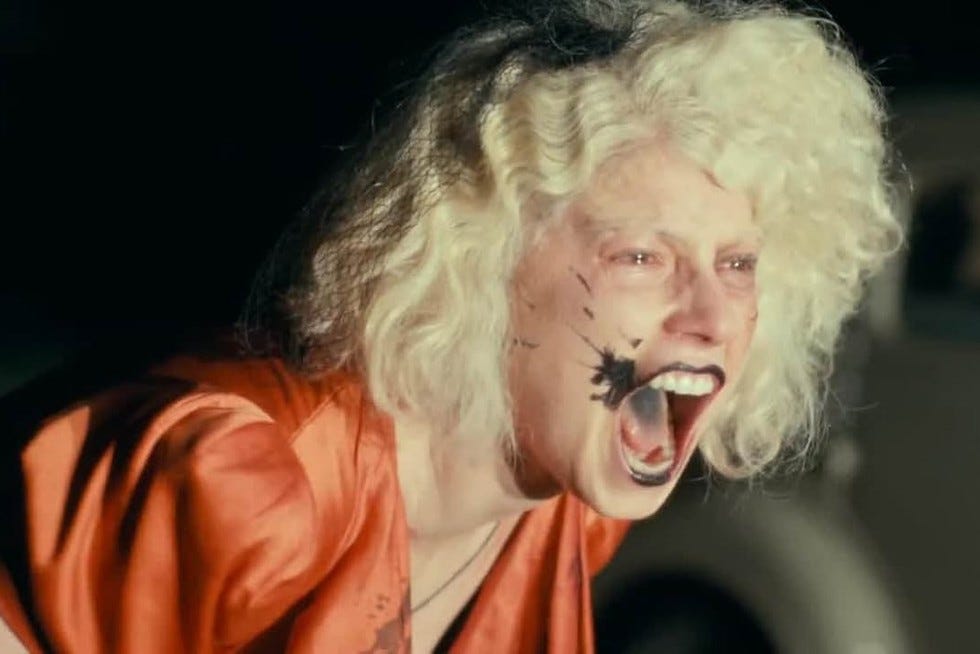
You’ll see a lot of defending this film because it’s a “feminist Frankenstein,” but the only feminist thing about this movie is that it proves that women can suck at making films just as much as men. The feminism here is hackneyed and trite — the Bride is angry about the way men have treated women, yes, but that’s as deep as the movie is willing to go. Every once in a while Jessie Buckley picks up a gun, points it at a man, gives an incoherent speech about how badly men treat women, before sprinting out into the night screaming, “Ahahahaaha!!!! Yes!!!!”
Somehow, this half-assed call to action serves to inspire women around the country, resulting in an excruciatingly stupid montage of women painting their faces to look like the Bride, shooting guns in the air, and screaming “Brain attack!” in the streets, while we see a series of newspaper headlines that are just embarrassingly empty Riot Grrrl references. (For a brief moment in this montage we also see — and I swear I am not joking — a shot of a 1936 woman twerking on the hood of a car.) This baffling eruption of proto-feminist violence goes nowhere and is never touched on again. The feminism in this movie feels like the cinematic equivalent of Rose McGowan taking a photo of herself raising her fist in the air and then going home, satisfied with another day’s work of activism. What are we fighting for? Who cares! Brain attack!
Female rage is obviously a rich and somehow still tragically under-explored territory in mainstream film, but the Bride is all rage, no substance. And sure, female rage at the expense of complicated interiority can be highly effective when a film commits to it (like, to name one off the top of my head, the spectacular Revenge, the first feature film from Coralie Fargeat, director of The Substance), but The Bride! wants to have it both ways, suggesting a rich inner life and larger questions for its protagonist without, you know, actually showing any of that.
The Bride is still, at the end of it all, just a woman with very little agency of her own: she’s been forced into violent actions largely via Mary Shelley mind-control (I guess?), and the only question the non-possessed half of her personality seems to have is, “What is my name?” Which — spoiler alert — comes to an extremely unsatisfying end, when she decides at the end to change her name, from “the Bride of Frankenstein” to simply “the Bride.” As if removing the husband’s name changes the fact that calling someone “the bride” is still a way to refer to her as only existing in relation to a man! After all that anger, all that rebellion, all that sticking-it-to-the-man, she is at the end of the day still just somebody’s wife. Sad! It’s a confusing message, like the kind of feminism you see on Love is Blind or tradwife TikToks, where it’s seen as empowering to be subservient to a man as long as you have a punk rock attitude about it. Go on girl, give yourself nothing!
Mistress Dispeller (2025) — on Criterion
This is an absolutely wild documentary, and I have no idea how they filmed any of it. It follows a woman called a “mistress dispeller,” which I guess is a thing in China, who is hired by wives to help chase their husbands’ mistresses away. So we follow the titular mistress dispeller as she gets herself involved in the husband’s life, and then the mistress’ life, while lying and manipulating them into realizing that what they’re doing is wrong. It’s wild, and the most insane thing is that everyone knew they were being filmed and signed releases?! I have no idea what the husband and mistress were told before filming (an opening disclaimer says that all participants signed onto the film before and after filming, once they understood the true purpose of the doc), but the raw, emotional footage captured would put some Real Housewives franchises to shame. And now that I know about this world and this mistress dispeller, I’m going to need more. I need a documentary about the making of this documentary, I need a full series following her work with different couples every episode, and I need the mistress dispeller to get on Survivor. She’d have Boston Rob crying within, like, an hour.
The Housemaid (2025) — on Apple TV
Unlike The Bride!, which is just bad bad, this is a perfect example of good bad. Sydney Sweeney is, of course, the worst actress in the entire world, and though I haven’t seen her in much, it’s shocking to me how little effort she seems to have put into a starring role opposite Amanda Seyfried. Sydney really is at peak marble mouth here, mumbling her way through the entire film. (At one point, she sips a glass of champagne and mutters, “It’s really bubbly…” which felt like the world’s worst ad lib that somehow made it into the final cut.) But Amanda Seyfried makes up for Sydney’s lack of energy with a performance that rivals The Testament of Ann Lee for Most Psychotic Amanda Seyfried Character of 2025. In fact, this could make for a strangely good double-feature with Ann Lee, if you want to spend 5 straight hours watching Amanda Seyfried terrorize people for having sex. And why wouldn’t you!
A Perfect Murder (1998) — on Criterion
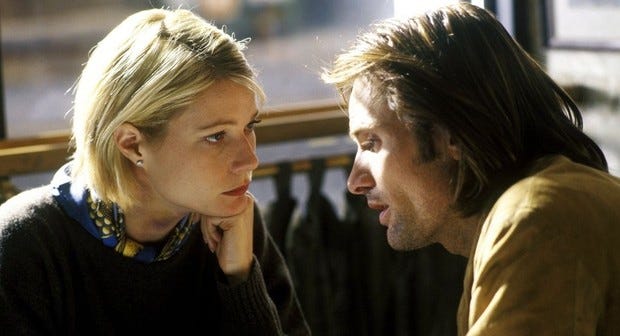
This is such a campy, twisty, perfect 90s thriller, a Hitchcock remake with three icons in their prime — Gwyneth, Michael Douglas, and Viggo Mortensen — who all happen to have basically the same haircut for some reason. There’s murder, sex, bribes, twists, turns, Gwyneth speaking Spanish with a Catalan lisp, Gwyneth speaking Arabic. Basically: everything you could ever want in a 90s film. A Perfect Murder on a rainy night, with a little joint? Bliss!
Gravity’s Rainbow, by Thomas Pynchon (1973), pages 1-519 — paperback
For the past two weeks I have been working my way through Gravity’s Rainbow and boy am I exhausted. It’s my first Pynchon, and I suppose I am enjoying it, although “enjoying” isn’t really a word I’d use to describe the experience. It will be worth it in the end, I can tell, but I can’t remember the last time I worked this hard at a book. If you’re looking for the cure to phone-addicted brain rot, Pynchon might be it, simply because there is no way to read him without using 100% of your brain’s focus. If I find my mind wandering for even half a sentence, I’m suddenly lost and need to go back 2-3 pages to start over. This is an intense, wild, sometimes annoying, occasionally beautiful experience. (I will say, if you’re going to take it upon yourself, the website gravitysrainbowguide.com is very helpful, especially when you’re picking it up the next day and need to remember wtf happened in the last section you read.)
One major theme of the book seems to be the separation between reality and fantasy: do fantasies come from reality? Or can fantasies create reality? Before reading this, I would have said the former, but now that I’m reading this book, which was written 50 years ago and is all about the rise of fascism, increased militarism, and an all-encompassing paranoia reinforced by extreme surveillance and shady corporate practices, I’m like……….. maybe fantasy and reality have collapsed? It’s all very — for lack of a better word, but actually now that I think of it this is literally the perfect word in this instance — Pynchonesque.
There genuinely is no one who writes better about paranoia. Just look at this section in which, after spending 400+ pages building up paranoia as an awful burden to bear, he flips it on its head and shows how the opposite might actually be worse:
If there is something comforting-religious, if you want—about paranoia, there is still also anti-paranoia, where nothing is connected to anything, a condition not many of us can bear for long. Well right now Slothrop feels himself sliding onto the anti-paranoid part of his cycle, feels the whole city around him going back roofless, vulnerable, uncentered as he is, and only pasteboard images now of the Listening Enemy left between him and the wet sky. Either They have put him here for a reason, or he’s just here. He isn’t sure that he wouldn’t, actually, rather have that reason....
And, really, is there anything more Pynchonesque than starting the most deranged and mind-altering novel about bombs raining down from the sky during World War II, right before the bombs start raining down at the start of World War III? This may not have been the most comfortable time to start reading Gravity’s Rainbow, but it is also tragically the perfect book for this moment. Fuck it, let’s have a paranoid summer.