
#89: Wuthering Lows

Death By Consumption
2/10/26 - 2/16/26
Okay, it’s time for the snow to melt. We’ve all had our fun, but I am absolutely sick of being stuck behind slow pedestrians on a sidewalk that’s been narrowed to a single lane of traffic between gray-brown walls of snow and ice. Just like any self-respecting gay New Yorker, I’m used to zipping down the street at lightning speed, elbowing tourists and old ladies in the ribs in order to get ahead. So every time I come to a screeching halt behind a slowly shuffling family of four, tiptoeing their way across the slush, I feel it as a personal attack. Why are you doing this specifically to me, I scream at the back of their heads, kicking out the knees from the youngest child in the group so I can leapfrog over him and get to the bar or movie theater 2 minutes faster than Google Maps told me it would take a straight person. Even worse is the horrific amount of dog shit left on the sidewalks — what is it about Americans that we think dog shit somehow melts with snow, so it doesn’t need to be picked up in the winter? Every step I’ve taken outside over the last month has been fraught with danger, a half-inch away from ruining my day with every step. I love dogs more than most people do, but these days, as far as I’m concerned, every dog owner is a fascist, willing to destroy innocent people’s lives rather than face even a single second of inconvenience themselves. The post-Trump truth and justice tribunals better make some room on the docket for city dog owners, is all I’m saying.
This week: I endured Emerald Fennell’s latest cinematic assault, I healed myself with Scorsese’s gayest film, I followed Elle Fanning into the depths of Disney hell, I relived the years Tyra Banks spent torturing and mangling young women for our entertainment, I marveled at modern anti-stye technology, and I read three newish books, wow!
“Wuthering Heights” (2026) — at Cobble Hill Cinema
I am an Emerald Fennell apologist, but even I can’t defend “Wuthering Heights,” her bloated, boring, gutless take on a classic. Somehow, Emerald Fennell — a woman whose previous work has given us grave-fucking, a naked dance number, and inspired the Tina Fey-coined phrase “sexually violent third act twist” — made a movie less shocking than the 150-year-old book it is based on. Emerald, girl: you’ve been out-scandalized by Emily Brontë, are you not ashamed of yourself?!
This movie needed to be 30 minutes shorter and 200% crazier. In retrospect, the obnoxious quotation marks around the film’s title should have been the giveaway that Emerald wasn’t confident enough to commit to anything, that the entire movie would run away from its own convictions. At times, it wants to be a sexually violent story that pays tribute to the emotional and physical horrors of the novel; but every time things start to get even a little bit weird, Emerald retreats to the braindead comforts of a weepy, rain-soaked, period piece romantic film, something you’ve seen a thousand times before. For every bit of genuine freakiness (Jacob Elordi’s Heathcliff licking the wall mid-makeout), there are ten times as many moments of melodramatic crying and longing in the rain. I’m bored!
Jacob Elordi and Margot Robbie, unfortunately, have nearly zero chemistry — Jacob literally has more chemistry with the aforementioned wall he licks. It’s hard to forget, due to the sheer size of him as he looms over a tiny trembling woman, that he is our reigning (Oscar-nominated??) Frankenstein’s monster. And yet I wish he had brought even more Frankenstein into the role; at least then we’d have had a Heathcliff worthy of the reputation! The Heathcliff of “Wuthering Heights” is mostly a doe-eyed sadboi who likes to tell you he’s dangerous and scary more than he ever acts on it. The dangerous liaisons between Cathy and Heathcliff are told, not shown, and if the characters weren’t spending every scene reminding you that Heathcliff is violent and cruel, you wouldn’t be blamed if you forgot it. In the novel, we see Heathcliff abuse children, servants, his wife — oh and he literally hangs a dog. But Jacob Elordi and Emerald Fennell’s Heathcliff has been so declawed, he’s closer to Heathcliff the cartoon cat than anything recognizable from Brontë’s work.
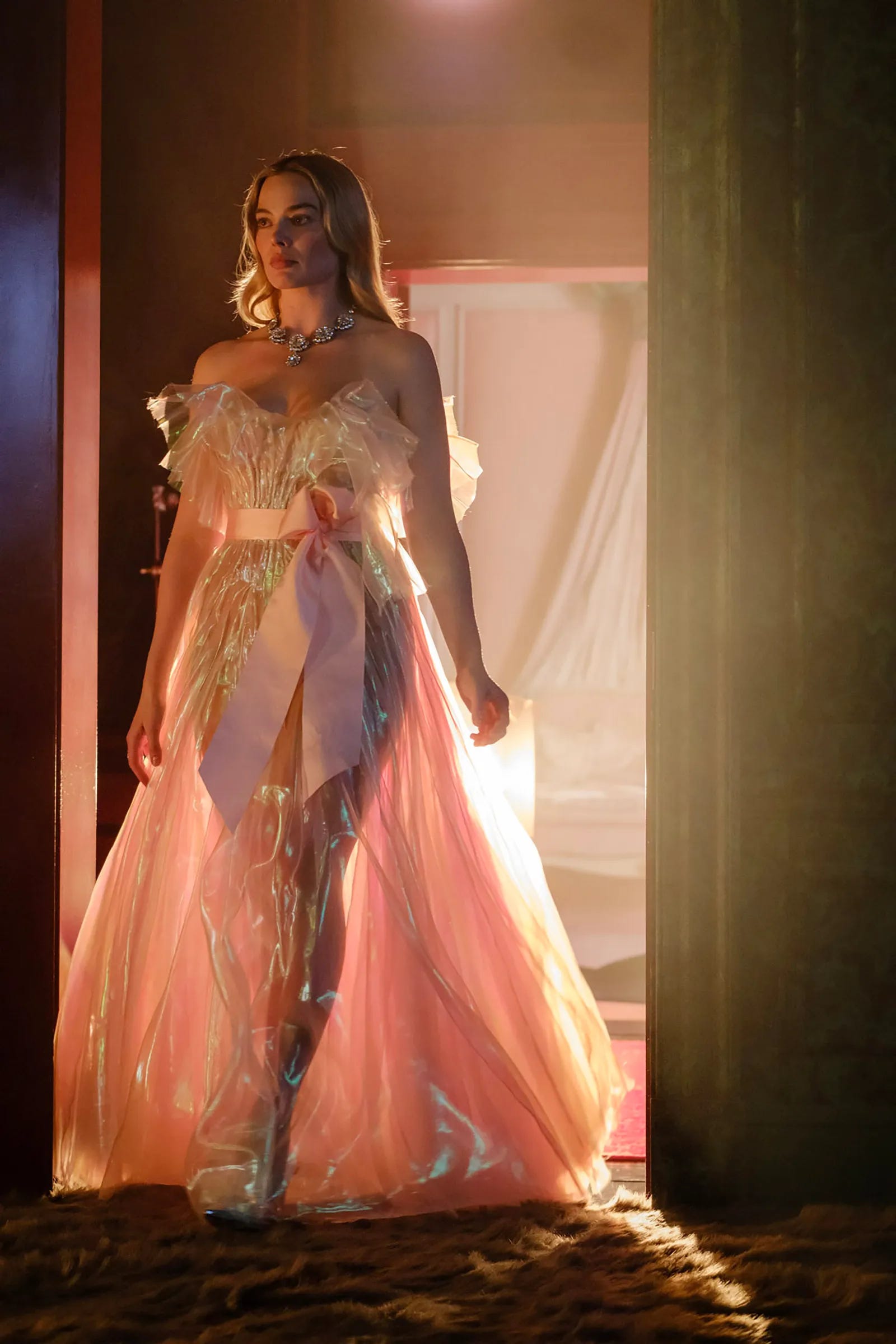
The whole time, you could feel Emerald Fennell unsure if she wanted to make the most fucked-up BDSM nightmare of her career, or an 1800s The Notebook, before deciding to split the difference, slapping some quotation marks around the title at the last minute to give herself a perfect out for any criticism. And it’s those quotation marks I keep coming back to. Those quotation marks, I know, will piss me off for years, if not decades. It’s an astonishingly embarrassing and cowardly decision, and also a pointless and stupid one: the quotes are meant to signify that this isn’t literally Wuthering Heights, merely one woman’s take on it, but like....... that’s how all movie adaptations work??? Does Emerald Fennell think if she hadn’t put the quotes there, we would have all, what, wondered if Emily Brontë collaborated with her on the script? Does she think other adaptations of other novels aren’t taking creative liberties? Does she not understand that every single time a director has taken 200-400 pages of a novel and compressed it into a 2-hour movie, they have been forced to make creative choices about how to adapt it in their own unique way? Does Emerald Fennell not know what the word “adaptation” means???
The title’s quotation marks are everything wrong with the film: they’re useless, poorly thought-through, a garishly obvious “joke” that thinks it’s a subtly clever wink. Someday, it would be nice to see an Emerald Fennell film that reveals what she actually thinks about the world, but I’m starting to worry there isn’t any thinking happening at all.
The Age of Innocence (1993) — on Criterion
I appreciate Criterion throwing Martin Scorsese’s The Age of Innocence onto streaming as a not-so-subtle “fuck you” to “Wuthering Heights.” You see, Emerald, this is how you adapt a 100-year-old novel about longing and forbidden love, no titular quotation marks required! This was, hilariously, sexier and more scandalous than all of “Wuthering Heights,” and it’s all pulled off while you never see any skin below anyone’s neck!
Daniel Day Lewis — young and more beautiful than you remember he ever was — is engaged to a comically wide-eyed Winona Ryder, while secretly falling in love with her cousin, a disgraced Countess played by Michelle Pfeiffer. The story is narrated, thrillingly, by Joanne Woodward, who helps you through all the interconnected family drama in 1870 New York City. It’s actually shocking to see a Scorsese film with this tone, like you’ve pulled up a sofa in a seating room and are being told the most delicious high society gossip. This is, to my knowledge, the gayest film Scorsese ever made, and made me realize that the Wuthering Heights adaptation we actually need is his.
Predator: Badlands (2025) — on Disney+
The male loneliness crisis affects Predators, too, apparently! People have dubbed this “the gay Predator movie” (which I get, but is wrong — the original 1987 film is gayer), since the story follows a Predator who’s rejected by his father for being weak. Eager to prove himself to his burly dad, he flies to “the death planet” to hunt the deadliest creature as a trophy to bring back to his tribe. But that’s all a simple setup to the real message of the film: the power of friendship. Yes, this is a Predator film that amounts to a “we’re stronger together!” message, and as a result it’s the most Disneyfied of the bunch. It has its decent moments, but the tone of the movie felt like one of the 5,000 films that lay downstream from the Marvel universe, where an exciting action sequence must be immediately undercut by a character being like, “Well, that just happened.” The only takeaway from this film was that I will, apparently, watch literally anything Elle Fanning is in.
Reality Check: Inside America’s Next Top Model — on Netflix
I found this three-part documentary on the Tyra Banks Prison Experiment known as America’s Next Top Model equally captivating and confusing. It’s unclear to me how much involvement Tyra had in the making of the documentary — at times it feels like she’s genuinely being put to the screws to answer for the crimes against humanity she perpetuated on her reality show, while at other times the documentary feels like a whitewashing of her reputation, if not promo for a return of ANTM. Either way, I watched all three hours in one sitting.
Those who know America’s Next Top Model already know its most psychotic moments — judges calling skinny girls “elephants” to their faces (and worse behind their backs), the blackface challenge (not joking), the forced surgeries (yes) — so the weakest parts of this documentary are the 20 or so montages that simply highlight the insanity of ANTM without commentary. But when they dial in on specific moments, there are genuine revelations here, most newsworthy the fact that the iconic “cheating scandal” of Cycle 2, in which model Shandi “cheated” on her boyfriend in Milan on camera (seriously: they not only aired her boyfriend SCREAMING at her on the phone, calling her a slut as she sobbed and hyperventilated, but they also aired her calling the Italian man she had sex with to ask him if he used protection or had any STIs — you truly had to be there), was actually a sexual assault.
This is the most harrowing section of the documentary, in which Shandi recounts the whole excruciating escapade: she wasn’t eating, because no one ate on that show, and the producers got her drunk with a bunch of Italian men they had hired to drive the girls around, and next thing she knew she was blacking out while he was on top of her, and the cameras kept rolling through it all. I remembered the Shandi spectacle from when it first aired, of course (anyone who’s been reading these emails for more than 2 weeks knows my brain is 90% reality TV mush), but I had never heard the truth of the matter, and it’s horrifying to see Shandi recount it and the ways it continues to ruin her life. Even worse is when Tyra and the other executive producer are asked about it in their interviews, and they brush it all aside with barely an acknowledgment that anything bad happened.
The most frustrating and fascinating aspect of this documentary is the decision from Tyra to be interviewed, alongside co-executive producer Ken Mok, plus former judges Miss J, Jay Manuel, and Nigel Barker. The three former judges make it clear they’re here to settle scores, after Tyra publicly fired and burned them, ending her friendship with them practically overnight, but the result of their vendettas against her is to frustratingly avoid any self-criticism. Any of the show’s evil behaviors they participated in were Tyra’s fault; they were, in so many words, simply following orders.
Tyra also refuses to accept blame for pretty much everything (the only time she admits she went “too far” is during the viral “we were all rooting for you!” meltdown, but even that she blames on some “Black girl shit that’s deep inside”), hand-waving any concerns off with vague admonishments that young critics just don’t understand “that’s just how things were back then.” Sure, we’ve come a long-ish way in 20 years (although, considering the state of things, it’s a little bit 2 steps forward, 3 steps back......) but it’s maddening to watch Tyra refuse to accept any criticism while acting like America’s Next Top Model aired in 1942 rather than the 2000s.
There’s a much more interesting, much more explosive documentary here, if they cared to look for it, about the abuses and extremes that were often required to make the iconic reality TV we all look back on so fondly. It’s a question that’s still grappled with today: can you make good reality TV ethically? And, to be honest, I don’t know the answer! Most of my favorite reality moments happened in the early 2000s, which can be partly attributed to the fact that, without social media or YouTube or even reruns of reality TV, people felt free to act like lunatics in front of the cameras without thinking about how it would follow them for the rest of their life. But these iconic moments are also, in many cases, attributed to the actions of producers with shaky ethics and boundaries — even a show like Survivor, which really does seem to have been one of the most ethical shows at that time, went through multiple rounds of horrific on-camera scandals (multiple sexual assaults that weren’t taken seriously, and a trans man being outed against his will, to name a few) before it started to focus more seriously on the long-term wellbeing of its cast members (and, probably as a result, has become a nicer and less dramatic show).
So, yes, America’s Next Top Model was all of it: iconic television, a product of its time, and seemingly a factory for abuse. And yet, as Tyra says to us viewers in the documentary while panicking to throw blame on anyone but herself, “You wanted this.” She’s not wrong! Because, at the end of the documentary, my first thought was: “Holy shit, that was fucked up.” But then my second thought was: “I should rewatch America’s Next Top Model.”
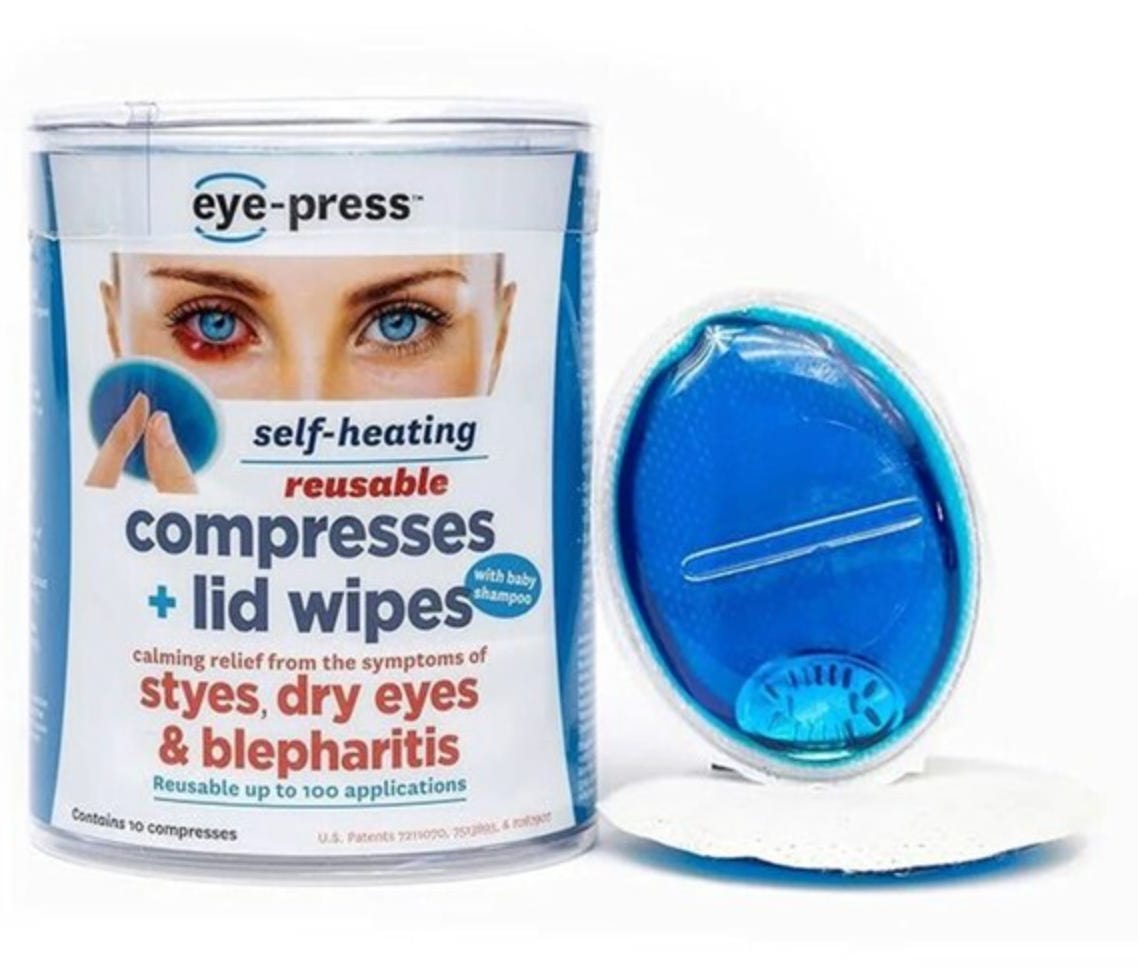
eye-press self-heating reusable compresses + lid wipes — purchased at CVS
As I bravely came out with last week, I’m currently battling the stye of my life, which may force me into eyelid surgery (???) next month if it doesn’t go away on its own. The only real weapon any of us have against styes are hot compresses, so, tired of heating up a damp washcloth 5x a day, I decided to try out these supposedly self-heating and reusable hot compresses I happened to see on a CVS shelf. And let me tell you: these are the most astonishing invention of the 21st century.
The compresses have a soft pad on one side (which is apparently soaked in baby shampoo to help clean your eyelids! So thoughtful!), while other side is clear plastic with a tiny little handle so you can comfortably hold it against your eye. Inside is a mysterious blue goop, the color of the ocean in James Cameron’s The Abyss, in which floats a small oval sliver of metal, like a button from the 1700s. To activate the self-heating mechanism, you simply flex the button back and forth, popping it like the top of a Snapple bottle’s lid, which immediately causes the blue goop to transform in a flash, from blue to icy-blue, from liquid to solid, in about 2 seconds. I can’t properly describe the experience, but I can tell you that — alongside bluetooth and smartphones — I’m 100% certain this technology has been reverse-engineered from a crashed UFO.
The heat lasts for about 10-15 minutes, the exact amount of time you should be compressing for, before turning into a cold plastic lump. But here’s where things get even more magical: to re-activate it, all you do is drop it in a pot of boiling water for 5 minutes, and it somehow resets to brand new. It comes out of the boiling water pliable and soft, the liquid once again ocean blue, ready to be re-activated via its metallic disc. I purchased a pack of 10, but I only use 4 of them now, in a constant cycle of boiling and resetting. Sure, boiling bits of plastic repeatedly and putting them against my eyelid is probably exposing me to all sorts of nefarious microplastics going directly to my brain, but what modern activity doesn’t come with a side of microplastics? And if it gets rid of the stye without requiring eye surgery, I’d say that’s a worthwhile exchange.
I have no idea what toxic chemicals are inside this little package, I have no idea what sort of evil conglomerate is behind this invention, and I’d rather not know. What I do know is that this is the kind of technology we should be funneling billions of dollars into, rather than AI or crypto. This is truly transformative. This is revelatory. This is the future we were promised.
The Passenger Seat, by Vijay Khurana (2025) — library ebook
This slim, tense book explores the idea that — well, I don’t know if you’ve heard this before, but, young men are kind of fucked up these days. In The Passenger Seat, two teenage boys run away from home and embark on an aimless drive “up north,” causing a hell of a lot of trouble on the way. Right off the bat, we know bad things are going to happen, and they do, but the violence is anything but predictable: I spent most of the book anxiously turning the pages, waiting for something awful to happen to these boys, or for them to do something awful, or, usually, both. It’s a quick, short little read, which is great because I really did not want to stay in their minds very long, and ultimately a sad one that offers no catharsis or platitudes, which I think makes it stronger. Boys are fucked up, and they crave intimacy, but often don’t know how to find non-toxic ways of being together. It’s sad and true, and Khurana never lets the boys off the hook for the awful things they do, while also finding moments of tenderness that speak to the deeper need within them, that force you to, at times, see the humanity behind the monsters in the headlines:
Teddy remembers the first time Adam took him to jump into the river. ... Adam vaulted onto the railing like it was nothing. When Teddy got up there they stood side by side, looking down. They both had to touch a hand to each other’s shoulder to keep their balance. He remembers Adam looking at him then, those small eyes, pupils tiny in the sun. Teddy was uncomfortable and chose to look down at the water, at the rocky banks closing in on the patch where Adam was assuring him it was safe to jump. Adam adjusted his trip on the stanchion and with his other hand nudged Teddy off balance. Instinctively Teddy stepped forward, only a fraction, to catch his weight, but there was nowhere to step. He can still picture the sight of Adam’s face in his peripheral. On the way down he decided he hated Adam, planned to put a knee right through his stomach. Or better yet, to walk up to Adam’s truck and take the handbrake off, let it roll right into the river. But once he struck the water, he saw that Adam was not up on the bridge, looking down at Teddy and laughing. Adam was right there beside him; he had followed Teddy down without Teddy realizing it. And this made Teddy wonder if he really had been pushed, or if they’d both just stumbled over the edge. Adam made a shrill, joyful noise, and Teddy decided then and there that he had enjoyed the fall.
The Mind Reels, by Fredrik deBoer (2025) — library ebook
This is another slim, tense book, but one I enjoyed a lot less than The Passenger Seat. It follows a young woman, Alice (of course), who loses her mind to severe bipolar disorder while at college. We follow the unraveling and paranoia, her frequent and frustratingly brief encounters with what amounts for mental healthcare in this country, and we exhaustively chronicle the medicines she takes. It’s bleak, and though it feels very realistic to the experience of having bipolar disorder, it feels like one of those books that’s important that it exists, but not the most enjoyable to read.
The Unveiling, by Quan Berry (2025) — hardcover
I enjoyed Quan Berry’s previous novel We Ride Upon Sticks, about a 1980s high school girl’s field hockey team that turns to Satanism and witchcraft to win matches, so was looking forward to The Unveiling, which sounded like a mix of LOST and Lovecraft. In The Unveiling, a group of tourists to Antarctica get stranded on an island, where strange things keep happening and the past comes back to haunt them. It has its fun and genuinely spooky moments, with some great, tense horror sequences, but I kept bumping up against the characters, who all felt obnoxiously one-note. This is by design — the narrator rarely uses their real names, instead referring to them by the character names she’s coined, like “The Baron,” for an obnoxiously arrogant older wealthy white guy — but that doesn’t mean I can’t be annoyed it. Rather than figuring out how to survive, the characters spend more time bickering about social and political issues, arguing about affirmative action and pronouns while literally starving to death. There’s a point to all of it, but not a very elegant one, and I never enjoy a book in which I’m hoping for literally every single character to die, and quickly. The genre of “horror as a way to unpack trauma” is well-worn territory, and while it can still find ways to surprise me, I didn’t find any surprises here.