

Death by Consumption
8/11/26 - 8/17/26
You know what? It’s hot, it’s late summer, and there are already a lot of words in this email, so let’s skip right past this little intro and get to it. You’re welcome!
This week: I watched the two big new summer movies that both happen to feature violence and lesbians (no, not Spider-Man, though please do let me know if there’s a lesbian twist to that movie I’m unaware of!); I was surprisingly charmed by a new movie about a sexy piano tuner; I continued my Odyssey odyssey by watching the other adaptation (and this one features Ralph Fiennes’ dick!); I got horny for Paul Newman; and I read two newer books, one set in the past and one set in the future, but both about how bad things are yaaaaay!
The End of Oak Street (2026) — at Nitehawk Prospect Park
You will see people describe this movie — in which Anne Hathaway and Ewan McGregor’s clunky American accent get transported from the 1980s to dinosaur times — as “bad,” as “stupid,” as “oh fuck I thought we bought tickets to Spider-Man?” But it is very very important that you do not listen to those people. The End of Oak Street is a perfect summer movie, a hilarious, campy, borderline insane film in which you can have the once-in-a-lifetime experience of watching Anne Hathaway blast a velociraptor in the chest with a shotgun. What more could you ever ask for?
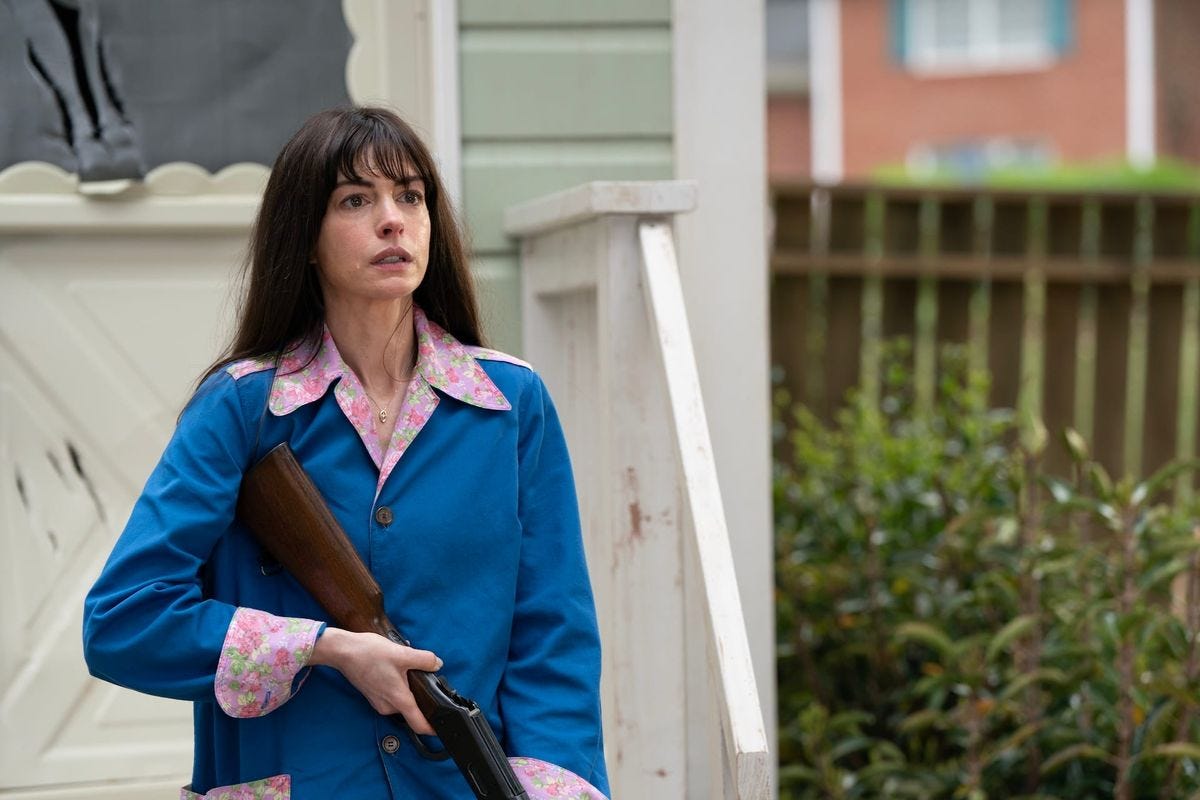
The film is simultaneously a callback to summer blockbusters from the 80s and 90s, but also something completely unique. It’s got dinosaurs, which is very 90s of course, but it’s also surprisingly mean to its characters, and has a rather bleak outlook on the world, which is all very 2020s. While the tone is campy and silly, the subject matter is surprisingly unpleasant: this family has been transported back to the time of dinosaurs and it seems like they’ll be stuck there forever, unless they’re eaten first, and there’s really no good way out of this! You could view this all as a metaphor for how bad things are, and how our future climate is looking increasingly hopeless and inhospitable to human life… but you could also turn all that pesky thinking off and just be like, wheeeeee, Annie’s got a gun!
That said, I suspect this is the kind of film you’ll either get or you won’t, as evidenced by the woman behind us who loudly yelled out — at the film’s climax, when something quite shocking and campy happens, making the majority of the theater burst out into laughter — “What is so FUNNY?” And I do feel somewhat badly for that lady, who seemed to have her movie-going experience ruined by people not taking the Anne Hathaway-blasting-velociraptors-with-a-gun movie as seriously as she’d like.
But the film makes it very clear that it was always meant to be campy — any doubt I had about the intentionally stupid tone was erased by an extremely last-minute revelation of one character’s completely unnecessary homosexuality. I am not exaggerating: within the literal final seconds of the film a character is basically like: oh btw I’m lesbian! And now that I’ve discovered that’s an option, for a movie to end with a character just suddenly being gay for no reason, I need more films to end like that. Instead of Marvel films ending with, like, Robert Downey Jr. showing up and teasing the next sequel, they should just end with Captain America announcing he has a boyfriend now. Look, if we have to spend our every waking minute listening to the unbearable whining of conservatives desperate to feel like victims despite controlling everything, making characters last-minute gay for no reason is a perfect way to troll the worst people on the planet. Gay people aren’t trying to turn your kids trans, but we are going to make Batman and Superman kiss.
So: if you go into this movie with the wrong mindset (heterosexual), you’ll probably leave confused, like the poor annoyed woman who sat behind us. But if you go in with a pure, campy, homosexual heart and minimal active brain cells, you’ll have a great time.
Teenage Sex and Death at Camp Miasma (2026) — at Nitehawk Prospect Park
This is a difficult film to write about, because there are some people who are going to love this film on a deep, visceral level (trans lesbians), and there are other people (me) who found it a surprisingly annoying experience to sit through. If you loved it: great! I’m happy for you. It’s always lovely to find a movie that feels like it’s speaking directly to you. But… boy did this one not work for me!
It’s especially maddening that I had this reaction, because on some levels this film should have spoken to me. I grew up on 80s and 90s horror movies, and even though I wasn’t aware of it on a conscious level, I grew up scanning those films for their gay subtext. I treasured my Freddy Krueger box set — my favorite in the series was the 2nd film, when Freddy is randomly kind of gay, and likes terrorizing boys in the locker room. So a film that’s all about using classic horror movie tropes to explore identity and sexuality and gender should have been right up my alley! But, unfortunately, Teenage Sex and Death at Camp Miasma falls flat under the weight of its own script, a deeply cringy piece of Late Millennial art that feels like it was written by an ex-Buzzfeed employee.
This is the kind of script in which the word “woke” is used as an ironic punch-line at least five separate times, and Hannah Einbinder speaks about late capitalism, but phrases it: “because of how late the capitalism is.” (I can’t even type it without cringing.) And, yes, I realize the film is actually poking fun at the modern tendency to replace our own thoughts and feelings and personalities with our favorite pieces of pop culture blah blah blah, but the critiques leveled here are so clunky and painfully wink-wink, coated in a thick slathering of millennial irony, that I found so much of this nearly unbearable to sit through.
The back half got a little more interesting — mostly because the characters stopped talking so much — but at the cost of losing any remaining sense of coherence. None of it will be any surprise to anyone who saw I Saw The TV Glow (Jane Schoenbrun sure loves a visual tone poem about gender dysphoria!), but after sitting through an endless barrage of trippy, weirdly ugly visuals that vaguely nodded at larger ideas, I got bored and just wanted Little Death to chop everyone’s heads off so the movie would finally end. What I’m saying is: this is not a movie for me, but it might be a movie for you, and isn’t that what’s so fun about movies? Maybe they should just consider banning all cis men from being allowed to see this movie. Certainly they should ban us from writing about it! Which means it’s time to move this thing along………
Tuner (2025) — on Apple TV
Tuner, which came and went as if it never happened, has a plot that sounds too dumb to possibly be good: a piano tuner with almost debilitatingly sensitive hearing discovers that he can unlock any safe just by listening to the clicking of the knob, and therefore becomes a burglar. Okay! In a week in which I watched Anne Hathaway blast a velociraptor in the chest with a shotgun, it’s impressive that Tuner is actually the craziest plot I sat through, but once you get over the inherent silliness, you discover this movie is… an extremely violent thriller mixed with a very cute romcom?
It’s a weird one! I see why this got very little attention when it was released, because it’s very hard to capture just what makes it work. And yet it does work! This is largely due to the charm of the cast: Leo Woodall, that very cute British boy who fucked his uncle in The White Lotus, plays the titular tuner, and his lovely sad eyes have never been wielded more effectively; Havana Rose Liu plays his love interest, a type-A composer who has great chemistry with Leo (who wouldn’t! He is, I must repeat, very cute!); Dustin Hoffman plays himself as usual but, as usual, it works; and Tovah Feldshuh anchors the ensemble as Leo Woodall’s adoptive mother of sorts. I found myself charmed throughout this movie, and then surprised at how charmed I was by the movie where a piano tuner robs people with his superpowered hearing? Between this and the new movie where Dua Lipa’s husband can’t legally have sex due to fascism, romcoms are clearly going through a bit of a covid brain fog period when it comes to narrative devices, but once you get past the strangeness, Tuner is surprisingly good!
The Return (2024) — on Paramount+
Oh, you thought we were done with The Odyssey? We’re just getting started! This adaptation came and went without nearly as much fuss as Christopher Nolan’s little indie film (not sure if you’ve heard of it?), but I thought it was an interesting companion piece — a quieter, slower, much more focused version, almost more of a stage play than a film. Most of Odysseus’s journey has been stripped away here, and the film focuses entirely on the titular return, when he arrives in Ithaca and, after some hemming and hawing, decides to win back Penelope.
Odysseus is played here by Ralph Fiennes, who went and got Marvel-ripped despite being in his 60s and the role not really requiring all of that (but it is appreciated!). And Penelope is Juliette Binoche, who has a lot less to do throughout most of the film than Anne Hathaway’s Penelope, until she suddenly, as Juliette is known to do, steals the whole show towards the end. Interestingly, The Return is interested in a lot of the same psychological questions as Nolan’s The Odyssey — PTSD, if you can ever truly go home again, what to do with a bunch of obnoxious guys who trashed your house, etc. — but many of the questions are played in a more understated way than in the bigger movie. Matt Damon’s Odysseus was always a moment away from turning to the camera and telling us what he was feeling, whereas Ralph Fiennes plays him much more subtly, trusting you to figure out why Odysseus’s homecoming isn’t as happy as you might expect. (Ralph also shows his entire dick for no real reason, which I suspect may have been a last-minute decision once they heard Matt Damon and crew were just around the corner, filming his own version of the story. Ralph knew he had one chance to one-up Matt! And he DID.)
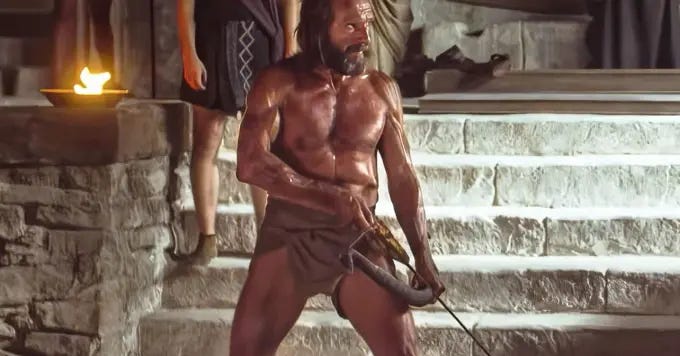
Everything is stripped back here, including the costuming — pretty much every character’s outfit is a blanket, wrapped differently. Some wear their blanket costume as a toga, others as a skirt, while others just throw it over their shoulders like they’re sitting on the porch on a crisp autumn evening. I know this was a deliberate stylistic choice by the production, but it sometimes feels as if they’re working with the budget of an Odyssey porn parody. And while there isn’t the amount of sex in this adaptation that would satisfy my horny classicist queen Mary Beard, it is the sexier, grittier, dirtier adaptation, which counts for something! So if you are, like me, spending your summer Odysseymaxxing, The Return is worth your time.
The Long Hot Summer (1958) — on Criterion
Did you know Paul Newman was hot? This is not a commonly known thing, but he was! And that is kind of the entire plot of The Long Hot Summer: Paul Newman plays a very sexy drifter, the iconically named Ben Quick, who gets chased out of one town after being accused of burning down a barn, and moves to a new town, where everyone is very horny for him, and very mad about being horny for a barn-burner.
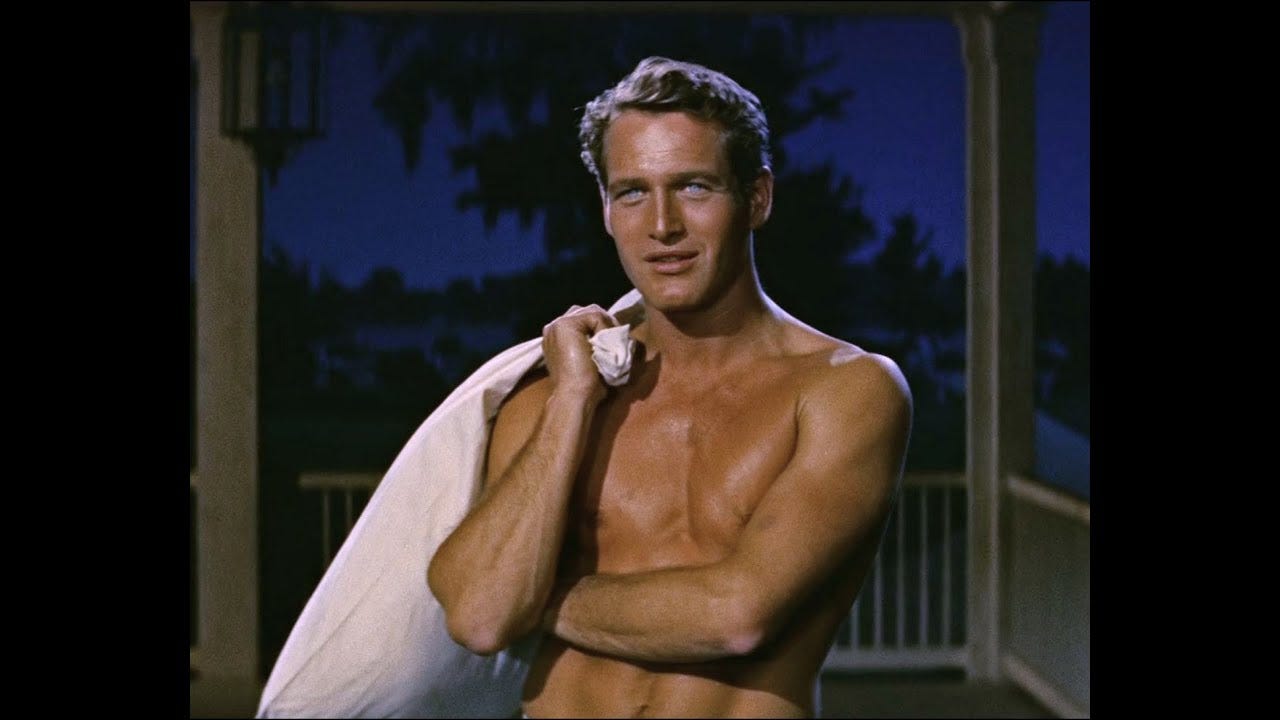
And, look, I’m never going to not enjoy staring at Paul Newman’s sparkling eyes for 2 hours, but The Long Hot Summer was so fun! The dialogue is Faulkner-meets-Tennessee Williams, so everyone is whipping one-liners at each other while speaking slow as molasses. Paul Newman is great as always (did I mention he’s hot?), but his chemistry with Joanne Woodward (who married him while filming this, and who can blame her) is off the charts. She’s an absolute star in this, acting circles around everyone, and there are several scenes in which their chemistry is absolutely electric, and I was just like: oh wow, these two are in looooove.
But the true highlight of the film for me was Orson Welles, who is as bloated and purple as that little girl who ate Willy Wonka’s blueberry candy, just before she got rolled away by the Oompa Loompas. He’s got a mouthful of marbles at all times, and he spends most of the movie getting drunk with Angela Lansbury. When we first meet him, he’s just out of the hospital after some undefined surgery, and Angela Lansbury asks him, “I hear they cut and stitched you up at the hospital. Is there anything left to have of you?” and he growls back, “You just put 18 bottles of beer on ice and we’ll see.” (Later they do, in fact, drink 18 bottles of beer on ice. I love them both.)
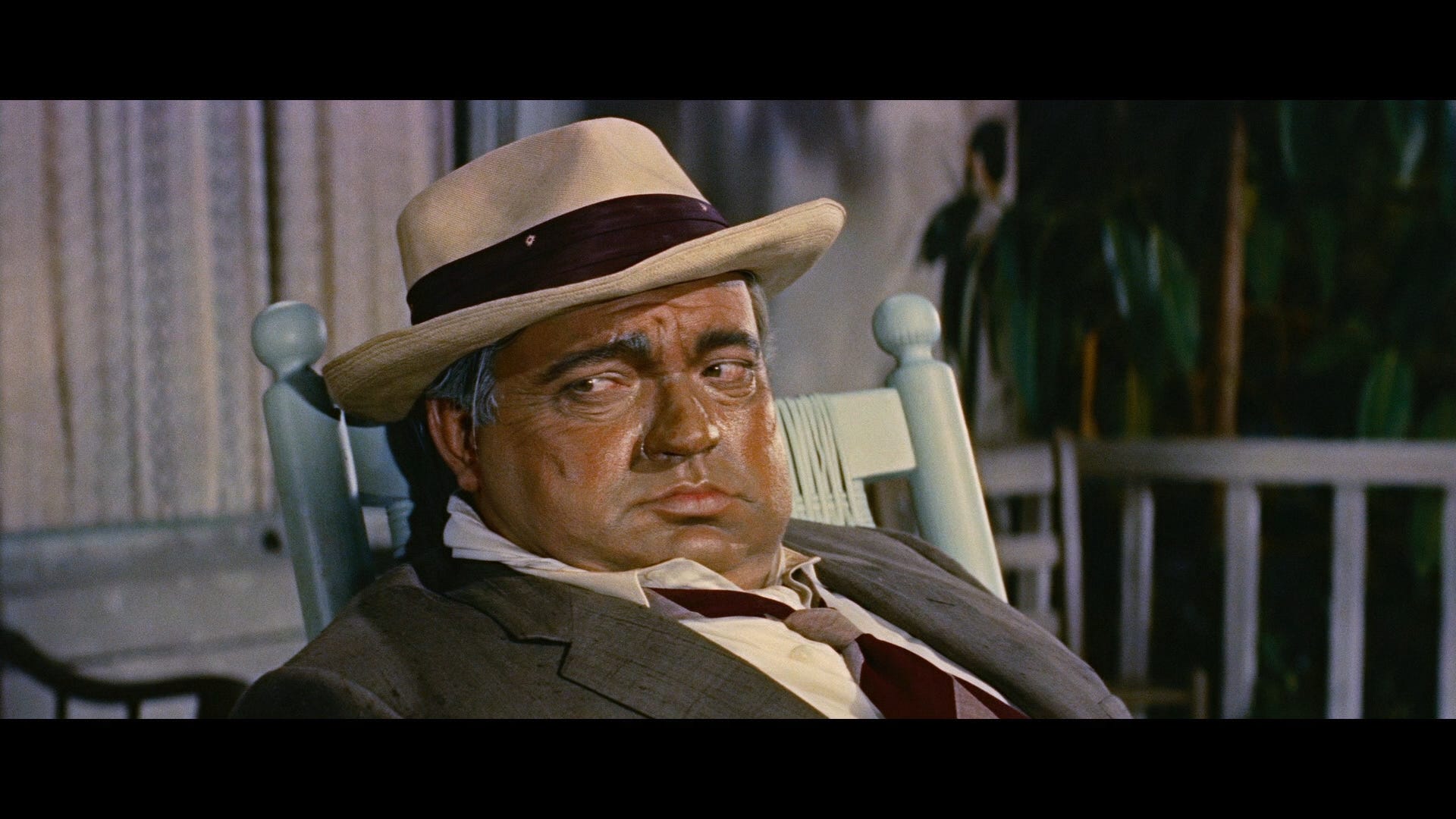
Orson plays Joanne Woodward’s father, the richest man in town, who starts out suspicious of Paul Newman but ultimately kind of falls in love with him. I’m not joking, that is the actual plot of this film: Joanne Woodward is somewhat engaged to a gay man (they never exactly say it, since it’s the 50s, but he still lives with his mother despite looking like he’s 45, Orson Welles calls him a “sissy,” and at one point Joanne asks him, “But do you like me, as a man likes a woman?”), but Orson Welles starts to push her to leave her gay-ass boyfriend in favor of marrying Paul Newman. Joanne Woodward reacts with horror, as, of course, anyone would react if they were pushed to have sex with that disgusting Paul Newman. I won’t spoil anything, but things get rather heated in multiple ways — between this and Cat on a Hot Tin Roof, which was released just 6 months later, 1958 was really the year of Paul Newman slutting around with a sultry accent, huh? Joanne was right to snatch him up so quickly! That bitch.
Mary Beard’s Ultimate Rome — on Pluto TV(??)
Mary Beard is my favorite Roman historian, and the person whose books I usually push people towards if they’re thinking about getting into Roman history. But, because I live in a backwater country without the BBC, I had no idea until recently that she has also created several documentary series about Rome on British television. This four-part series, a high-level but still delightfully detailed overview of all of Roman history, aired over a decade ago, and can only be found on the random-ass streaming service Pluto TV, which is free and therefore feels like some sort of money laundering operation.
However Pluto makes their finances work, I’m glad they exist so that I could enjoy watching Mary Beard traipse around the Mediterranean in a linen top and sensible shoes, shamelessly touching ancient artifacts (she puts an ancient helmet pulled from a shipwreck on her head, proudly declaring she’s probably the first person to wear it in 2,000 years, and I genuinely gasped — you can’t do that, Mary!!!). What makes her brilliant is her ability to take complicated historical concepts and simplify them without dumbing them down, and how easily she cuts through the bullshit that often gets forced on ancient societies by modern interpretations. Her Rome is racially diverse and full of real people who had real lives and real emotions — it feels lived-in and the opposite of stuffy and dusty. This little series is a fantastic introduction to Rome and to Mary Beard, but also to history itself. History can be fun, I promise!!!!
The Gods of New York: Egotists, Idealists, Opportunists, and the Birth of the Modern City, 1986-1990, by Jonathan Mahler (2025) — hardcover
This book — which I reportedly read at the same time as Zohran Mamdani; mayoral book club!!! — tells the story of the years 1986-1990 in New York, which were, apparently, very formative years! It’s a great, comprehensive overview of a surprisingly dramatic period in this city, which, because New York is the only city that matters, ended up affecting not only the country, but the world. This period covers police brutality, the AIDS crisis (and the government’s failed response to a pandemic), rising income inequality, white collar crime, the splintering of media, and the beginning of the rise of Trump and his various scams. And yet, despite all that, this was somehow a mostly enjoyable read! It’s an impressive feat, to get me to not want to throw a book across the room in 2026 that heavily features Giuliani and Fauci and even James Comey, but he somehow did it. And I finished reading it before Zohran did!
Earth 7, by Deb Olin Unferth (2026) — library ebook
Another surprisingly fun book despite it being about how everything sucks now! This very short, very readable new novel is set in a climate-ravaged future, when humanity barely exists on Earth anymore (most seem to have relocated to Mars, where life also sucks, yay!). In it, a mother-daughter duo deal with the trauma of, like, everyone and everything dying, and are focused on preserving the DNA remnants of all the species that went extinct (so: all of them). The story is, as you can imagine, unrelentingly bleak, and yet full of heart and humor. Reading the following passage while it’s been in the 90s for weeks and Europe is on fire and the super El Niño is barreling towards us to destroy all our crops or whatever isn’t exactly comforting, but it is very darkly funny:
Then there’s the sun, that bitch. The sun hates us, that much is clear. We are squinting and suffocating. But what are you going to do? It’s the end-time. Every part of the planet is done with us: the air, the ground, the water. They’ve had it with humans.
I always want to leave you on a hopeful note. You’re welcome!