
#112: The woke Odyssey is not woke enough, says Emily Wilson, wokely
What if this newsletter pivoted to only Odyssey content

Death By Consumption
7/21/26 - 7/27/26
As I type this, I am trying and constantly failing to not lock eyes with the construction worker who is literally 7 inches from me, working outside my window. Two years ago the dreaded scaffolding went up around our building, and everyone in NY knows that when the scaffolding goes up, it never comes down. And now that the construction on our building’s facade has moved to the wall outside my apartment, I can see why it’s taken this long — these guys aren’t doing fucking shit!!! This man lays a single brick, then picks up his phone, records a voice message to send to someone, puts down his phone, yells something at another worker, scrambles down the scaffolding to go talk to that guy, scrambles back up, finally lays a second brick, and starts the whole process again. Yesterday, he placed eight bricks on the wall, total. Today so far he’s managed two. I was mad at first, until I started writing this and took several breaks in between sentences to look at my phone, talk to other people, walk away from my work, etc. etc. etc. Sooooo I guess I really don’t have any higher ground at all. But that won’t stop me from being annoyed!!!
This week: I’m still not done with The Odyssey and neither is the internet thanks to Emily Wilson’s new thrashing of Christopher Nolan, I finally finished the absolutely perfect new season of Couples Therapy, I wished a young Rob Lowe had been gayer with a young James Spader, and I read a good new book about a twisted mother-daughter relationship.
“An Uncomplicated Man” by Emily Wilson — on the London Review of Books
In the week since I saw it, I have yet to grow tired of thinking about, talking about, and arguing about The Odyssey. So it was thrilling when Emily Wilson (an iconically controversial classicist and translator of The Odyssey and The Iliad) dropped this nuclear bomb of a film review on Christopher Nolan. I loved the film, and I also love ancient historians, but I love mess and drama even more than both of those things combined, so this is huge for me, personally.
Emily’s complaints are many and varied, and not the ones you’d expect from a classicist. She’s not here to complain about historical accuracy or nitpick specific tweaks to the story beats — she’s not here as a classicist at all, in fact. Instead, she’s taken to the page to kickstart her brand new career as a good old-fashioned film critic. And boy does she have some things to say:
Nolan’s Odyssey lacks many of the elements that make the poem great. It has nothing convincing to say about time, memory, history, war, or about the relationship between one warrior’s glorious return and the lives of his family, adversaries, comrades, friends and neighbours. It lacks psychological, emotional, political and ethical depth. Its narrative structure is gimmicky. The writing is abysmal. None of the characters has convincing motivation for their actions or words. There are no sex scenes, and all the food looks horrible.
Damn, she’s even coming for the food stylist!!!! Emily comes out swinging in this review and never lets up on anyone — by my count, she’s starting a fight with at least four different Hollywood unions. She has opinions on the abilities of many of the actors (Tom Holland is “good at playing a gormless young man of twenty going on twelve” lol), she hates the loud soundtrack, and she even seems to have hated Odysseus’s adorable, loyal dog. But more than anything, she despises the screenplay:
As they say at the awards shows, I was humbled to learn that Nolan has read at least the first line of my translation of The Odyssey into iambic pentameter. In at least one interview, he cited my version of the first line of the poem: ‘Tell me about a complicated man.’ But I would be ashamed to have written any part of this script.
This is a glorious mess of the highest order, a spectacularly unnecessary little thrashing that I’m incredibly grateful for. Look, Emily Wilson could have stayed in her lane and written an extremely pedantic little critique of the inaccurate costuming, or the childish way the movie boiled the concept of xenia down to “Zeus’s Law.” But no no no, Emily decided to treat the London Review of Books like her very own Letterboxd, and now everyone is extremely pissed. For a blissful 24 hours, my social media was entirely devoid of miserable updates about the end of the world, and instead was full of takes and countertakes and counter-countertakes, as everyone tore each other apart over Emily’s review.
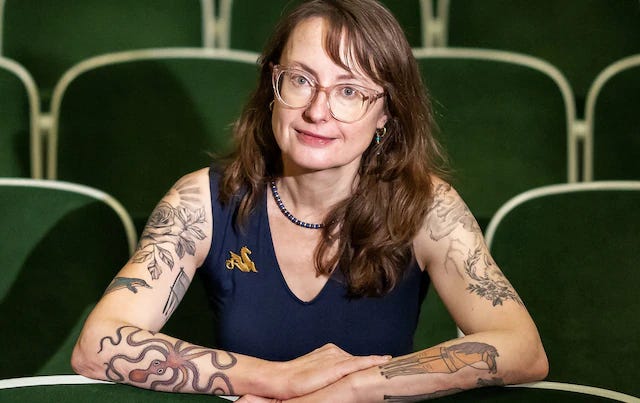
The biggest issue seems to be the following paragraph, in which she (rather inelegantly) has issues with the non-white characters in the movie — but she’s not mad about their casting, like the right-wingers have been for a year. No, she’s mad for even woker reasons than you could even imagine:
The race-neutral casting of Nolan’s Odyssey was inevitably deplored in some quarters. But there is nothing progressive about it. Most of the non-white actors – Zendaya, Lupita Nyong’o, Himesh Patel, Corey Antonio Hawkins, Travis Scott – play versions of the Black best friend, whose only role in the drama is to provide aid to the white protagonist. Scott, as the Ithacan bard, Phemius, yells a few words and pounds a stick, but does not get to sing, tell a story or play the lyre: the most melodic note in the percussive soundtrack comes from the plucking of Odysseus’ bow (a beautiful sonic image of the archer as musician, borrowed from the poem). Nyong’o’s double part as Helen and Clytemnestra is hugely underwritten; she is given only a few minutes of screen time to perform a set of brief tableaux of female victims (the outraged bereaved mother, the abused wife, the repentant adulteress).
Uhhh… does someone want to tell Himesh Patel he was playing “the Black best friend”? He might find a couple parts of that very surprising! Look, it’s fair and fine to point out that some of the characters in the film got short shrift, and that some of those characters were played by non-white actors. But to paint them all as the “Black best friend” feels like… more of an Emily problem, to be honest? Travis Scott was literally playing a bard — his entire role is to tell a story. That’s it! It’s not like in the original Odyssey we ever find out the motivations or, like, hopes and dreams of any bards! So her complaint that Travis Scott didn’t get to sing or play a lyre is fine, sure (I would have loved to see Travis Scott play a lyre, actually), but that has nothing to do with the point she just made in the very sentence before that, where she called him the Black best friend. Best friend to whom?? If the bard were played by a white actor, would it be an issue that we never learn more about his character and motivations, or is this a thing where, because a Black person was cast, now the character needs to do something to justify why he’s Black? What I’m saying is: can’t a bard sometimes just fucking tell a story and also be Black????
So now Emily Wilson has done what she did best, and pissed off the right and the left. Everyone wants to claim her for their side for different reasons, and also everyone is mad at her for the opposite reasons. She’s woke but also anti-woke. Christopher Nolan made the woke Odyssey and the right has been melting down for weeks about it, and then Emily Wilson wrote a review in which she said he wasn’t woke enough, and now everyone on social media is upset that Emily Wilson’s review was either not woke enough OR so woke it’s racist. Every time you think you’re woke, there’s someone more woke waiting in the wings to yell at you.
And, unfortunately, this only makes me want to read Emily Wilson’s translations even more. Whenever someone emerges as a messy diva like this, I feel an urgent need to dive deep into their entire catalog. It’s like the first time I saw a clip of Teresa Giudice’s table flip and I knew in my bones that I was about to watch all of The Real Housewives of New Jersey from the beginning. So while I don’t think Emily Wilson has a sparkling future in film criticism, I will say she absolutely knows how to get attention and sell a book. There are Lena Dunhams everywhere for those with the eyes to see.
Couples Therapy, season 5 — on Paramount+
This remains the most fascinating, intense little show. I watch it like other people watch sports: talking back to the screen, shouting advice, arguing with the decisions. Couples Therapy offers the voyeurism and sense of personal superiority you get from trashier shows like Love Island or Love Is Blind, but wraps it all in a “we’re helping people!” disguise — a spoonful of medicine to make the sugar go down. It is equal parts exploitative and genuinely helpful, terrifying but optimistic. If nothing else, it’s a chance to eavesdrop on the most intense drama happening behind the closed doors of a handful couples in the tristate area. And this season’s cast of couples are some of the most brilliantly fucked-up pairs the show has found.
There’s a politically split couple (she’s a Facebook lefty, he’s brainless MAGA); a married couple getting over the husband’s affair and also so so so much family trauma that causes him to go blank, or as the wife refers to it, have “shark eyes"; there’s a transwoman dating a man newly diagnosed with autism who are a fucking mess; and there is a lesbian couple that have been together for decades and might be getting divorced soon but also might be having another kid soon, tbd. These people are fucking crazy!
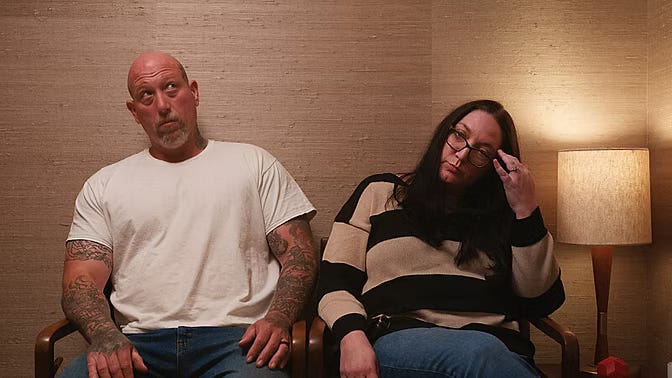
The new season has been out for a while now, and we’ve been making our way through it, but slowly. I find it utterly impossible to binge — even a single 25-minute episode is almost too much to bear in one sitting. These people are raw and real in a way that reality TV has mostly lost in our influencer-choked world, and though it feels a little ridiculous to say, I do find going on Couples Therapy a genuine act of bravery.
It’s not like these people are going on TV to become influencers — as far as I know, no one has parlayed an appearance on this show into any sort of viable career change (though I have come dangerously close to starting a petition to GET DR. ORNA ON THE TRAITORS. Can you imagine???). And yet, these people are baring the most horrific, traumatic, brutally honest sides of themselves and their relationships, all for people like me to critique and mock from our couches while shoveling dumplings in our faces. They’re exposing so much more of themselves than anyone’s ever been asked to do on, like, The Bachelor, and what do they get for it? A year’s worth of free, televised therapy, and probably a bi-weekly run-in with a parasocial fan of the show who starts trauma-dumping on them while they’re just trying to buy some groceries. Why would you ever do this to your life!
While all four couples this season are compelling in their own ways, the lesbian couple is one of the most captivating duos they’ve ever had. These two have such a complicated relationship that slowly unfolds as we get to know them, with a few genuinely shocking twists and turns as they come to therapy from week to week. There were several points in this season where I thought, “Oh wow, we’re actually watching people decide to divorce right now,” and then, a few minutes later: “Never mind, these two will be together for another five decades.” (Some people would say, “typical lesbians!” but not me! I would never say that! Some people would, though…)
What makes these two especially captivating is the way they are able to articulate their feelings. As someone of middling and arguably toxic therapy experience (I’ve ghosted all my previous therapists for getting too close to the truth, but I’ve stayed with my current guy for over a year now, mostly because I like how MAD he makes me), I find it genuinely impressive to watch other people able to speak about their own complicated feelings with such clarity and openness, rather than doing what I do in therapy, which is to try to distract him with jokes. At various points in this show, either one of these women would go off on a dramatic monologue that felt like it was being performed on stage. I swear, their therapy sessions felt like they were written by Tom Stoppard.
So I felt rewarded in my assessment and love for these two when even Dr. Orna broke her therapeutic distance in the final episode with them, thanking them and saying it was “such a treat” to work with them, calling them “deliciously smart.” And once again, I was watching this show like sports, cheering at my TV screen at Dr. Orna giving the lesbians the respect they deserved. Throughout a harrowing season, where I felt a deep, dark dread anytime one of the three other couples appeared on screen, watching these two intelligent, thoughtful women work through their issues and possibly even grow from a silly reality show was like a little beacon of hope. And, if nothing else, it helps me feel justified in continuing to watch trashy TV — look, it can sometimes help the people it’s exploiting! Anything to help me sleep at night.
Bad Influence (1990) — on Criterion
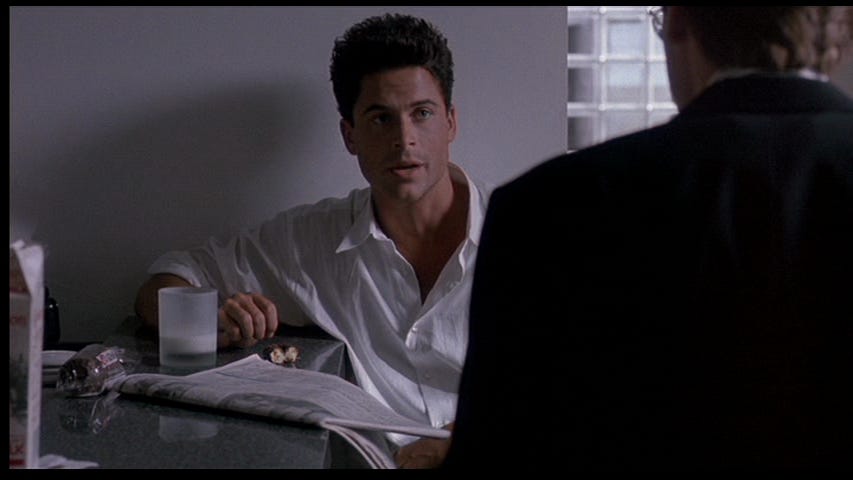
This film — in which Rob Lowe shows up as a sexy and mysterious con man who encourages a buttoned-up James Spader to loosen up and start committing crimes — feels like it didn’t have the balls to go full gay. Sure, it has its fair share of Tom Ripley-esque homoerotic undertones (particularly when Rob Lowe makes fun of James Spader’s O-face), but a braver film would have gone much further. There are hardly any vaguely longing glances between the two men, and for all the time Rob Lowe spends hanging around James Spader’s apartment as an unwanted guest, I don’t think he ever does it shirtless in an ostentatious display of his toned abs and perfect skin that makes James Spader, for only a brief moment, question everything. I’m not saying it had to go full gay, but we couldn’t even get a moment where Rob Lowe steps out of the shower, loosely wrapped in a towel, and James Spader’s eyes flick downwards before he quickly pulls them back up, only to see that Rob Lowe has caught his glance, and is now smirking suggestively at him? We can’t even get that???? Then what the fuck was the point of this shit!!!!
Pool House, by Mary H.K. Choi (2026) — library ebook
The rare book that feels like a perfect book for summer and like it could be the book of the summer. Pool House is a smart, complex, twisted little book about the relationship between Moon, a C-list actress and former sitcom star, and her daughter. With Moon’s career having stalled, the two women make money by renting out their main home, and living in the pool house, and their world is turned upside-down when Moon’s TV husband and one-time lover kills himself, which brings her former TV son back into her life. The three of them get into a fucked-up little love/parent/child/mess triangle, and the book moves fluidly through each of their perspectives.
This is one of those books in which not a lot happens, until it suddenly all does, and instead it uses most of its space to make these three characters feel as fleshed-out and real as possible. Their history is complex and strange, and they bump up against each other in interesting, pulpy ways. Is Adam more of a brother to Moon’s daughter, or a love interest? Is Moon more of his surrogate TV mom, or is she a love interest? And how can he and Moon reconcile their former relationship — she the experienced actress playing his mother, he the young star learning the ropes from her — with his new status as a successful movie star? The relationships are complex and real, even if you’ve never been a C-list actress (but really, who hasn’t), and she expertly uses this specific world to open up questions of race, class, money, family dynamics, alcoholism — you name it!
It’s also just a great book about modern times; this is possibly the first book to ever name drop Las Culturistas, and yet Mary H.K. Choi somehow does it in a way that doesn’t feel like she’s trying to prove she “gets” the internet. (In fact, I just looked up Mary H.K. Choi’s age, and I was shocked to learn she’s in her 40s rather than, like, 25 max, so clearly she was successful at capturing what it’s like to be young — he says, as a man nearing 40.) Her writing is playful but not annoying: a dick pic is “springing out of the screen like an IMAX warhead,” the penis looking “eager and well-meaning, like the kind of kid who’d wear bow ties on picture day.”
This is exactly what you want from a summer read: it’s easy breezy to page through, but with characters meaty enough to really chew on. If you were a book club person (I am NOT — book clubs are too full of people with the wrong opinions on everything), I can imagine this would do very well with the group. There are so many sides to these characters to disagree over! I’m not surprised to learn that Mary H.K. Choi’s early two novels were written for young adults — this feels exactly like the kind of “adult” book a young adult writer would write; it feels like the plot of a CW drama, but viewed through a more grown-up lens. And in the dog days of summer, this is exactly what you want: a sultry, sweaty little book about glamorously fucked-up people in LA.
I can't wait to see this horrific Odyssey so I can read your last two newsletters - I'm one of those people who can't bear to know anything about a movie or book before I see of read it. Once I do, I'll gladly dive in and dish with you.
On a separate note, I did see The Invite, and like you, loved it. That movie made me feel respected (for having a brain) rewarded, amused and touched. I want to be Penelope Cruz so I can say "look at my boobs" with a straight (and stunningly gorgeous) face.