
#110: The Invite is hetero hell perfection
Olivia Wilde has earned the right to fuck any pop star she wants!

Death by Consumption
7/7/26 - 7/13/26
I know this is such a manic pixie dream girl thing to say, but: I think my apartment is being haunted. A couple weeks ago, a woman seems to have died in our building (long, upsetting story!), and ever since then our lights have been acting strangely. You see, because Justin is a technofreak, we have motion-activated lights in our living room that gently guide your way to the bathroom at night, so you don’t have to turn on any bright lights. But since this woman died, I have regularly been waking up between 1 and 4 am with a feeling of pure terror, only to look out into the living room to see the motion-activated lights activating on their own. I then lie in bed for up to 15 minutes, trying and failing to get up the courage to go see what’s going on. While lying there, I watch the lights gradually light their way towards me, from the living room into our bedroom, before they switch off and start the process again, my skin breaking out into full-body goosebumps. Finally, after mustering all my energy, I jump out of bed and slam our bedroom door shut, locking it (ghosts can’t figure out locks?). By the morning it’s all a vague blur, and somewhat silly and embarrassing to remember, but in these witching-hour moments I experience nothing but the raw, genuine terror you can only get while half-asleep. So, like, uhhhh what do I do? Should I get like… sage? Hire an Etsy witch? Call one of those ghost hunter shows? If any priests are reading this, please help!
This week: I marveled at Olivia Wilde’s comeback, I watched sheep solve a mystery for some reason, I ogled Marilyn Monroe, I saw and immediately forgot a dumb movie, and I enjoyed the absolute genius and chaotic mess that was James Baldwin’s life.
The Invite (2026) — at Nitehawk Prospect Park
Finally, a movie for grown-ups! We’re only halfway through the year, but I find it hard to imagine another film will pop up over the next 6 months that I’ll enjoy as much as The Invite. It was just so fun! As far as I’m concerned, after making this, Olivia Wilde can fuck any pop star she wants. The woman has earned it!
Starring just four incredible stars — Olivia herself, Seth Rogen, Edward Norton, and Penélope Cruz, all at the absolute top of their games — and one very art-directed apartment, The Invite simply follows two couples having a dinner party, where things quickly and hilariously devolve thanks to the messy business that can arise from marriage and sex and having extremely hot neighbors.
The acting is pitch-perfect (god it’s good to have Edward Norton back!), the directing is lively and smart, and the script is spectacular — and randomly written by Rashida Jones? (I just looked up whether Rashida Jones has had this illustrious screenwriting career I didn’t know about, and got immediate whiplash from this portion of her Wikipedia: “In November 2020, Jones started the Bill Gates and Rashida Jones Ask Big Questions podcast with co-host Bill Gates. In December 2020, the podcast ended after its fifth episode.” What the hell is this woman’s career?)
After the disaster that was Don’t Worry Darling — and by “disaster” I am only referring to the film itself; the disastrous press tour was actually a masterpiece — I genuinely did not think Olivia Wilde had a film like this in her. And I will accept my lashings for that! I am sorry, Olivia: The Invite is legitimately genius, an immediately iconic entry into the pantheon of dark relationship comedies. This is Olivia’s Adele post-divorce album. This is Olivia’s Kelly Clarkson post-divorce album! This is Olivia’s Princess Di revenge dress.
Actually, no: this is Olivia’s adaptation of Bravo’s The Valley. Real Valleyheads know that show is the darkest program ever put on TV, a bleak look at the miserable post-marriage, post-baby lives of heterosexual couples who hate each other, and The Invite is plumbing those same depths, just with much funnier, hotter people (and with less shitty apartments). Sure, one is reality TV and one is a feature film, but they’re both in the same post-marriage, pre-divorce genre. The appeal of The Valley and the appeal of The Invite are the same: if you’re single you can feel so much better about not being tied to some obnoxious idiot, and if you’re in a relationship you can think, “Well at least we’re not that bad.” And with things so terrible in the real world, isn’t it nice to luxuriate in someone else’s hilarious nightmare for a while? The Invite is a scathingly brilliant boots-on-the-ground report from the front lines of hetero hell.
The Sheep Detectives (2026) — on Amazon Prime
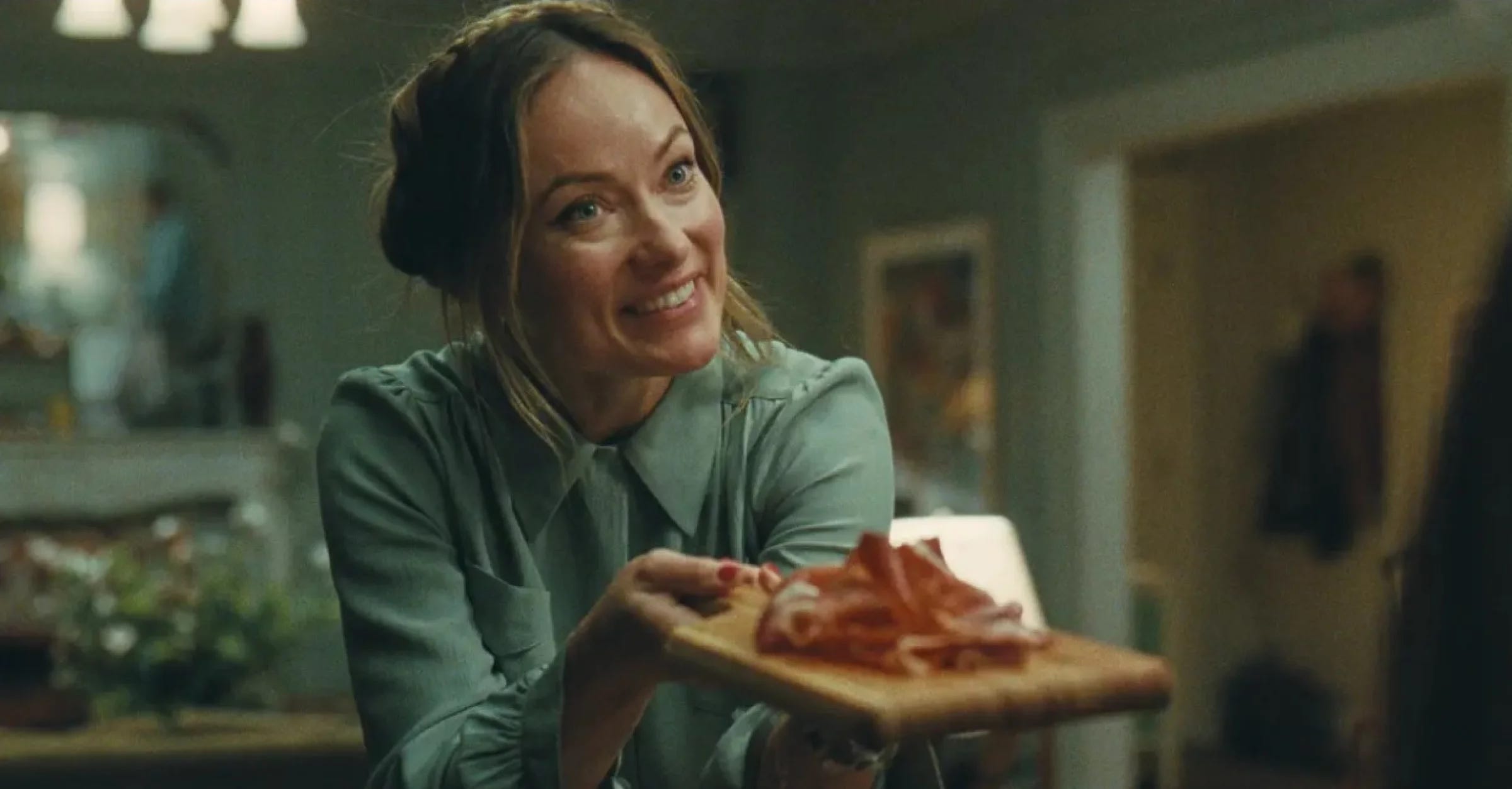
For some reason I decided to follow The Invite, a movie made for adults, with The Sheep Detectives, a movie where talking CGI sheep help solve a murder. And, look, this movie did get a couple laughs out of me — there are some truly bad jokes in here, which are unfortunately so bad they’re kind of good — but it could best be described as “sweet” more than anything else, which is an adjective that always turns me off from any piece of media (that’s the only way people have described Ted Lasso to me, which is why I will never, ever watch a second of that god-forsaken show). So: this was fine! Better than it should be, really. It’s genuinely better than either of the Knives Out sequels, but of course that’s a very low bar to clear. (Though, the funniest part of the entire film for me actually happened a few days after I watched it, when Justin referred to it as “that goat movie.” Kind of!)
Niagara (1953) — on Criterion
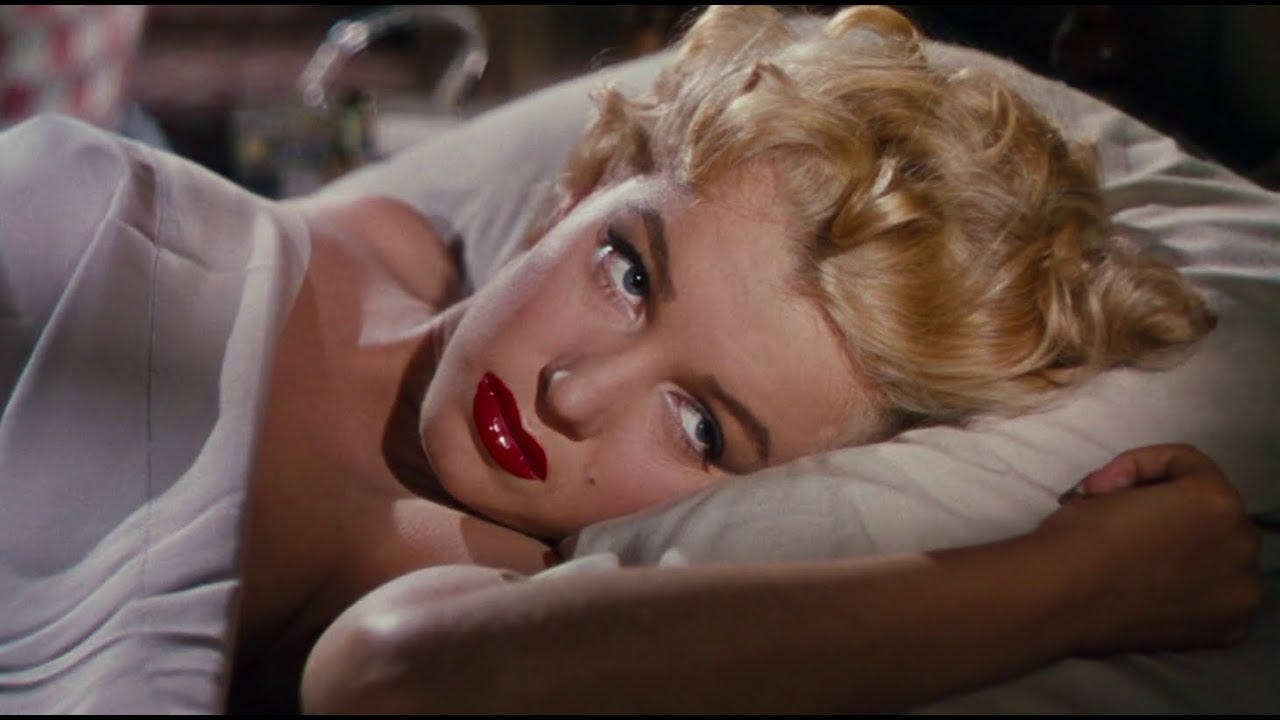
Due to some poor alcohol-mixing decisions on Friday night, I spent Saturday with a devastating hangover in which the only thing I could tolerate watching was, for some reason, this Marilyn Monroe noir. And I had a great time! The plot is as twisty as some of the best Hitchcocks, the Technicolor is stunning, and the acting is completely insane (Max Showalter seems to have been dropped into this murder noir straight from the Borscht Belt, and I kept praying for his death). Marilyn is the femme fatale, a woman who convinces the man she’s having an affair with to kill her husband by throwing him into Niagara Falls. It’s such a fun role for her, as she gets to slink around and scandalize everyone’s 1950s snowflake sensibilities. A woman with curves? Avert your eyes!
At one point in the film, Marilyn steps out of the shower in a full face of makeup, lips absolutely slathered in drag-queen-red lipstick despite the water all over her face. She then slinks into a hot pink dress, steps outside her motel room, and puts a sexy little record on to entice the other hotel guests to dance with her — which, of course, sends her husband into a violent, public rage. It’s all very dramatic and very silly and I was living for every second of it. Look, Marilyn was not the best actress, and especially not at this nascent stage of her short career, but she’s undeniably a fucking movie star here. There are endless shots of her sauntering away from yet another man who’s pining after her, which almost turned me — a fully gay idiot — into a cartoon wolf howling at the screen. She’s got the acting skills of Gal Gadot, but Marilyn proves in Niagara that you don’t need to act to be a movie star. I think this gal is going to be big!
Ready Or Not 2: Here I Come (2026) — on Disney+
A very stupid but fine sequel to the very stupid but fine original. A lot of the fun of this one comes down to casting, namely in letting Sarah Michelle Gellar be a psycho, and in getting Elijah Wood to be… Satan’s lawyer? I have no idea what was going on throughout most of this, but I just turned my brain off and let it ride. There are worse movie franchise ideas than a bunch of Devil-worshipping families competing via a deadly game of hide and seek, so… whatever! I can already feel every single moment from this film fading from my memory, though. If you ask me next week if I’ve ever seen this movie, I will confidently tell you I never have. Oh well!
Baldwin: A Love Story, by Nicholas Boggs (2025) — library ebook
James Baldwin was such a messy bitch!!! This new, lengthy biography of James Baldwin tells of his life, writing, and activism through the lens of his most important relationships. It’s a brilliant lens to view him through, as we see time and time again how directly his writing comes from whatever the hell is going on in his life at the moment of writing. And boy did James Baldwin always have some sort of nonsense going on in his love life!
We learn he wrote his first novel — which he had been struggling with for years — while living in a tiny Swiss village with Lucien, a Swiss painter who becomes one of the great loves of Baldwin’s life. The thing is, though they clearly had a sexual relationship at times, Lucien also appears to be barely bisexual, and clearly did not want a serious relationship with Baldwin, or at least in the way Baldwin wanted from him. (Though, it must be said Lucien is just as messy as Baldwin: he has a baby with a woman, marries her, and then names the baby Luc-James. Not long after the baby’s birth, Baldwin invites Lucien to come live in New York with him, and Lucien agrees, temporarily abandoning his wife and child. These two were insane!)
James Baldwin is truly, deeply chaotic throughout his entire life, but also he’s obviously an actual genius — he’s the kind of person who casually tells a friend, “I’ll probably get a Guggenheim,” and is right; but also the kind of person who crashes on his friend’s couch and then gives them all bedbugs. He borrows money from Marlon Brando several times and never pays him back (while also hooking up with Brando — I’m jealous!!!). As a young writer he gets under the wing of Richard Wright, the most famous Black novelist at the time, before launching his career by publicly shredding Wright’s work in a series of published essays, absolutely torching his relationship with his first mentor for a little taste of fame. (He later asks Richard Wright for money, too — he was always asking everyone for money — and they reportedly got in a screaming match at a bar. Divas everywhere!) The more I kept reading and loving his charismatic combo of chaos and brilliance, the more I kept wondering: was James Baldwin… the Lena Dunham of the 1950s?
Of course, the deeper we get into the Civil Rights Era of the 60s and 70s, and the more Baldwin’s work shifts towards activism, the more he has to grow up. We follow him as he becomes a central part of the push for civil rights, even as he privately remains unsure about his place in the movement — he’s constantly torn between wanting to stay in Europe or return to the US and fight. He’s not only experiencing an internal push-pull with the movement, but an external one as well; there are some not surprising but still shocking moments of absurd homophobia from other Civil Rights leaders, who didn’t want someone queer to be so visible in the movement (Baldwin was supposed to talk at the March on Washington before MLK’s iconic speech, but was barred by the organizers).
The more serious things get in the US — and, reading through the murders of Medgar Evers, Malcolm X, both Kennedys, and MLK in back-to-back-to-back succession really makes it clear we are not living through a uniquely dangerous time in America; things have been bad for a long, long time — the more fiery Baldwin’s writing gets, and the book is full of incredible excerpts from not only his essays but also his private letters, which were just as if not more fiery than his public statements. And, in an era where the worst people alive love to trot out the most anodyne MLK quotes to quiet any dissension, it’s very refreshing to read Baldwin speaking clearly about violence in our country:
The America of my experience has worshipped and nourished violence for as long as I have been on earth. The violence has been perpetrated mainly against black men, though — the strangers; and so it didn’t count. But, if a society permits one portion of its citizenry to be menaced or destroyed, then, very soon, no one in that society is safe.
This book is genuinely stunning in the way it achieves such an intimate look at Baldwin’s inner life. You feel his pain, his desire, his self-hatred, his ego, his anger, and his absolutely messy dating life. He’s funny and raw and genius, but an accessible genius. It’s clear that Baldwin struggled to feel accepted or known anywhere or by anyone throughout his life, but in Baldwin: A Love Story I felt like I got an intimate look at one of the most important and messiest people of the past century.