
#106: I'M A SPORTS GAY NOW
[Carrie Bradshaw:] In the nick of time... I became a Knicks fan

Death by Consumption
6/9/26 - 6/15/26
I don’t know what happened to me this week — maybe it was something about the oppressive heat, or the fact that my sister, brother-in-law, and their two kids visited and stayed in our little apartment with us — but, in the depths of Pride Month, I started to act like a heterosexual. I drank more beer than I’ve had all year, I watched more sports than I have in my entire life, and I enjoyed all of it. What’s happening to me? I’m scared!
This week: I contracted a fatal case of Knicks fever, I was confused but also delighted by Disclosure Day, I regretted dipping my toes back into Netflix true crime, and I read two books about sad people.
Cans of Modelo — on the street, Brooklyn
Up until last week, this had been my journey with the Knicks:
Birth to 2026: Considered it a cute thing my mostly straight male/lesbian friends enjoyed. I was glad they were having fun!
Game 1: Met my friends at a bar to watch, but I was a huge bitch about it. Left at halftime.
Game 2: Didn’t watch.
Game 3: Didn’t watch, hoped the president would stroke out on-air.
Game 4: Didn’t pay much attention in the first half, but felt slightly sad about the Knicks’ 29-point deficit; not genuinely sad, but sad in the way you feel, like, when a coworker tells you their plant died, you know?
But by the end of game 4, everything had changed. I was on my feet, screaming. I was texting friends. I was annoyed with Taylor Swift’s bandwagoning for attention (even though I am, at this very moment, also bandwagoning the Knicks, but I think we can all agree I’m doing it in a much less irritating and more interesting way). I even started using “we/us” pronouns to refer to the team. Within a span of about 15 minutes, I had become a completely different person. Nothing would ever be the same.
So when game 5 hit on Saturday, there was no question I’d be watching. After we got out of Disclosure Day (more on that below… lol), we walked around South Park Slope and Windsor Terrace, trying to find the perfect place to watch the game. Which was surprisingly difficult! I’ve seen other people point this out, but this was the first time I can ever remember New York feeling like it does not have enough bars. If you weren’t in the doors of a place by 8pm, you weren’t getting in, so we walked around until we stumbled upon a projector someone had set up in the middle of the street, which could not have been more perfect. We bought some Modelos at a bodega and set up on the curb, and by halftime the street was completely packed, hundreds of New Yorkers gathered around this single, random projector.
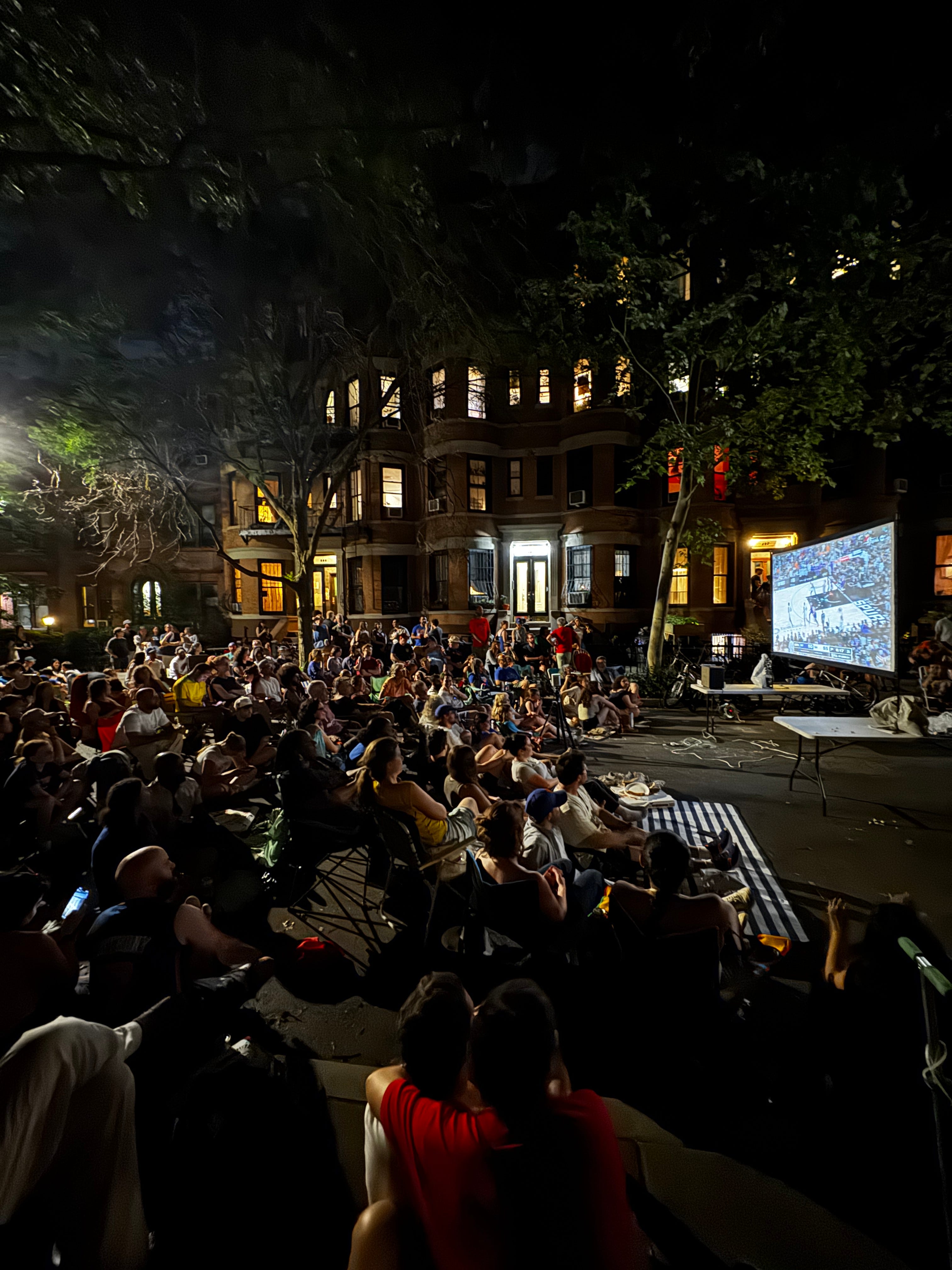
Much has been written and posted about the energy on Saturday night after the Knicks won, but as a person who had been rooting for the team for exactly four days, I think I’m the correct authority to tell you that it was truly once-in-a-lifetime. It was the first time I’ve seen purely uncomplicated joy erupting on the streets of NY like this in my 15 years here, and made me realize that maybe, possibly, there’s a slight chance that… the sports people have been right all along? Is this what you guys have been feeling and experiencing all this time?! Does this mean I have other preconceived notions that could be wrong??? (Not possible.)
I can’t promise I’ll be an NBA fan next year, but I am suddenly more open to it than I ever have been in my entire life. Should I get a Jalen Brunson jersey? Should I become a guy who yells, “Let’s goooooo!” all the fucking time? Should I put my life savings into a Kalshi account?! Watch this space……
Disclosure Day (2026) — at Nitehawk Prospect Park
In retrospect, it’s hilarious how many conspiracy theories there were in the lead-up to this film’s release. Steven Spielberg was being used by the government to soft-release actual disclosure! He had spliced into the film actual alien footage! Emily Blunt’s weird clicking voice was a real recording of real aliens speaking! And then, after all that, you see the film and it’s… a fun but very stupid, late-Spielberg summer blockbuster. Who would have guessed!
And, ironically, the conspiracies and paranoia that surrounded the release of the film completely destroy its central narrative. In the film, Steven presents “disclosure day” as a moment for the world to pull back from the brink and come together under a collective humanity. But in reality, we’d simply turn full alien disclosure into more raw fuel for memes, conspiracy theories, and deranged content, before quickly pivoting to the next topic of the day, like we do with everything else. What I’m saying is: if Disclosure Day were to actually happen, it would only take 10 minutes before some dude had created an AI video of himself fucking one of the aliens as promo for his OnlyFans.
But that is where my internet-ruined brain goes, while Steven Spielberg is much more innocent and hopeful than I could ever be. So instead of dwelling in our modern reality, Disclosure Day plays in a more Aaron Sorkin-esque place, one where things are kind of bad right now, but we can turn things around if someone just gives an inspiring speech on the evening news. It’s an extremely Boomer way of looking at the world, but Spielberg is 100 years old, so I’m not going to waste energy being mad at him.
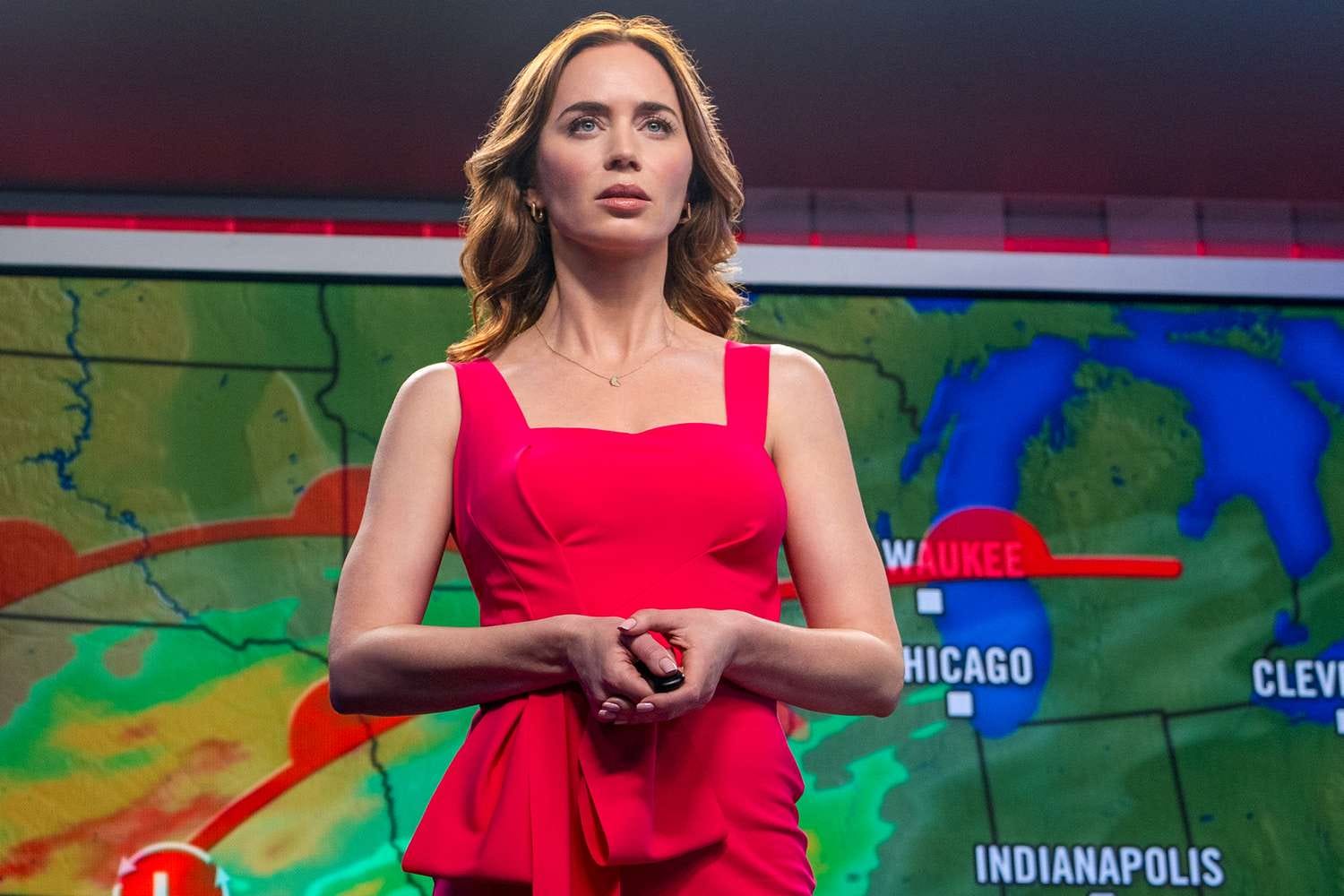
Unfortunately, Disclosure Day’s script and story are mostly a complete mess. There are vague psychic powers, a magical alien device that can do literally anything the plot needs it to do, and nefarious corporate villains who feel pulled from the later seasons of The X-Files and (spoiler alert) just kind of give up? The less time you spend thinking about the plot, the more you’ll enjoy the movie, is what I’m saying. This is damning with faint praise, but it’s the best advice I have for you.
Because if you do manage to turn your brain off a little, there are so many fun, electric sequences where Steven Spielberg is making the camera move in that specific Spielbergian way. I watched half the movie just like: wheeeeeeeeeeee! So many films are shot in such a flat way, designed to be streamed on your phone while on the toilet, so to see a big film with actual visual artistry behind it is thrilling. The bar is low, yes, but that’s not Steven’s fault!
Maybe, when the real Disclosure Day finally comes, we will learn that there actually have been psychic meteorologists and magical glow sticks and aliens presenting as shitty CGI foxes all along, and I will have to eat my words. But until then, my best advice is to just ignore the confusing plot completely and enjoy the movie for the big, stupid spectacle it is. Steven Spielberg has made possibly his dumbest movie of all time, but I still enjoyed the ride.
Maternal Instinct (2026) — on Netflix
This one’s on me. I should know better than to watch a Netflix true crime documentary, and yet something compelled me to click play on this movie, to my great regret. It follows an absolutely horrifying tale of a deeply unwell woman whose lies and petty crimes start spiraling out of control, until things take a very, very, very dark turn. It’s a bleak and horrible ride, the worst form of true crime, almost reveling in the misfortune of others. Even worse, the movie seems to be pushing for the death penalty? In fact, it goes so far beyond pushing for the death penalty that it feels like it’s pushing for something worse than the death penalty. This whole thing had a deeply conservative feeling to it, like it was a Heritage Foundation-produced film. I regret every second I spent watching it. Spare yourself!
What We Can Know, by Ian McEwan (2025) — hardcover
Ian McEwan’s writing is always gorgeous, but this book took a while to get into. It follows a group of academics 100 years in the future, who are researching a poem that was written in 2020 but has been lost to time. The first half of the book follows the academics’ attempts to rediscover the poem, as well as to retrace the lives of the poet, his wife, and the friends who were in the room for the one and only reading of this poem. The second half travels back in time and reveals the truth of what happens.
The book is full of weighty themes — climate change, aging, memory loss, the power of art, to name just a few — but I kept getting bogged down in the strange details of the actual story. For one, Ian McEwan seems to believe that a poem — and not just a poem, but a poem that has never been published; the idea of a poem! — could go massively viral in 2020. Even worse, the book supposes that a poem could inspire a wave of people finally taking climate change seriously. …….. Maybe!!!! It’s all very quaint, and I found that aspect the hardest to suspend my disbelief for (coincidentally, this is very in line with Disclosure Day’s insistence that broadcast news still carries an enormous amount of weight; it’s Boomer Media Week here at DBC!).
But there are some good emotional truths in here, namely the way the people of the future look back at us, the absolute fucking morons watching the world burn and doing nothing about it: “They were big and brave, superb scholars and scientists, musicians, actors and athletes, and they were idiots who were throwing it all away,” the academics of the future lament, and unfortunately that feels like exactly what they’ll be saying about us in the next century.
About halfway through, the book finally gets out of its stuffy academic world, and we start getting into the drama, which is where things really took off for me. Everyone in this book is cheating on their partner! There are more than a few soap opera twists, which feel extra shocking coming after 100+ pages of fictional poetry analysis, but were a welcome shift in tone. Is this what academic life is? Are all you literary theorists having scandalous affairs?
Sadly, I think we’re past the point where any single piece of art could change the course of our planet’s miserable climate future, but I suppose it was nice to live for a little bit in a fantasy world where that could be possible. I hope for everyone’s sake that I’m wrong and Ian McEwan is right, though.
Palaver, by Bryan Washington (2025) — library ebook
Bryan Washington is the gay male Sally Rooney, a writer deeply obsessed with a specific type of character and a specific world. And yet there’s something compelling about the repetition, the way these authors remain fixated on exploring extremely similar stories and relationships, with only minute differences between their characters. It’s like they’re both scratching a scab they refuse to let heal, finding new pains and new places to bleed from.
So, yes, this is another Bryan Washington novel about a sad queer Black sadboy living sadly in Japan, but it was the most I’ve enjoyed one of his books in a long time. The story follows a man — simply referred to as “the son” — in Japan, whose mother (“the mother”) comes to stay with him. As to be expected with dear old Washington, not much happens plot-wise, but conversations are had, emotions are fraught, sex is awkward but nice, and past wrongdoings are unearthed and dealt with. You know what you’re getting when you open one of his novels, and yet I haven’t gotten sick of it yet. And clearly, neither has he!