
#105: J.Lo’s new movie is crazy, but Cape Fear is crazy good
Let’s talk about a lot of fucked-up couples!

Death by Consumption
6/2/26 - 6/8/26
Another week, another work trip. I’ve really been living my 1950s businessman fantasy this year — kissing my adoring wife goodbye, slapping my fedora on my head, and boarding a plane with nothing but a corporate expense account and a dream. And yet, through it all, I simply must keep consuming! I tremble to think what would happen if I didn’t.
This week: I was baffled by the new J.Lo romcom, I watched a 90s classic thriller, I loved the new Cape Fear remake, I beheld the horrors of The Valley, I became fascinated by yet another villa of idiots, and I read a book about a sad gay.
Office Romance (2026) — on Netflix
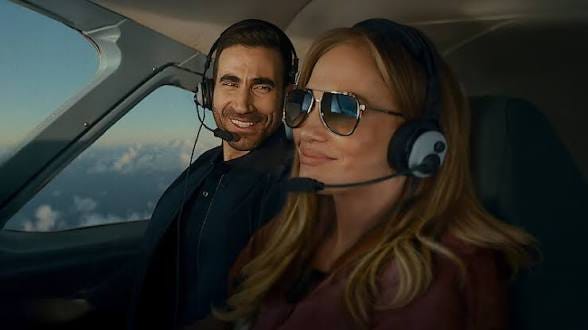
Forget the generic, algorithmically generated title: Office Romance is one of the most deranged romcoms Jennifer Lopez has ever made. Written by her costar Brett Goldstein — who is apparently from Ted Lasso, a show I refuse to watch, and who I find handsome but in the way a video game character is handsome; like, why do his face, voice, and movements all feel AI-generated? — J.Lo stars as the CEO of an airline company who falls in love with her new lawyer. That is a very stupid idea to base an entire movie on, and feels a bit like Brett Goldstein played Mad Libs before sitting down to write the script, but I suppose there have been crazier romcom setups (many of which have starred J.Lo herself), so I’ll give it a pass.
The core plot is decent, if strange: J.Lo is the CEO of an airline company started by her dad, Edward James Olmos, and she is very attracted to her new lawyer, but she can’t get together with him without pissing off her company’s board, who all want to oust her and bring in someone they think is more competent. But this is a problem, you see, because these are two very attractive people, so they struggle to keep their distance. (At one point — and I am not joking here — Brett Goldstein’s character gets a very obvious erection just from shaking Jennifer Lopez’s hand. I actually do think this happens a lot to her in real life, to be fair.) Basically: the whole move is a little like Succession with brain damage.
The two of them have fine chemistry (more on her side, though; again, there’s something about Brett Goldstein that feels like he’s a PlayStation character come to life — he looks like his legal, government name should just be Henchman #3), so the movie hums along quite charmingly, actually. But what makes it extremely watchable is the deep bench of wildly unstable side characters, most notably Betty Gilpin, who steals the entire movie with even the smallest facial expressions, and has one of the most psychotic birthing scenes ever filmed — and it’s easily the craziest birthing scene ever put in a romcom (if you want to see for yourself, go to Netflix, fire up this movie, and go to the 1 hour 20 minute mark. I’m sorry!).
But the craziest parts of the movie have to do with the characters’ backstories. You see, J.Lo is irresistibly attracted to Brett Goldstein, we learn, because she has a British kink! This is played for laughs, of course, but also taken somewhat seriously, which is weird. Anyway, it results in them having a little sex scene in which he dresses up as a Buckingham Palace guard so she can grope him while he has to stand still. Even crazier is the reason why Brett Goldstein hasn’t moved back to London — he’s stuck in New Jersey because his sister is in prison for a genuinely psychotic reason (spoiler alert: she chopped off a man’s head with a machete!), which doesn’t really serve any purpose to the plot other than explaining why a British person would willingly live in New Jersey.
I have this complaint about every movie, but this could have been 20-30 minutes shorter and would have been a perfect, stupid film. As it is, it drags at times, but I didn’t care. I haven’t met a Jennifer Lopez romcom I haven’t loved, and the dumber they are, the better. Thankfully this is one of her dumbest (but not the dumbest, unfortunately; that honor still goes to The Boy Next Door, in which she is famously gifted a “first edition” of The Odyssey). The woman is so charming she can life literally any material she’s given, what can I say!
The Game (1997) — on Criterion
I can’t believe The Game hasn’t been remade yet. It’s perfect for our current era of billionaire bloat and corporate paranoia. (Although you could argue that, in a weird way, The Chair Company is a The Game remake. Really, think about it!) This is such a fun, silly, perfectly 90s thriller about how rich people are so bored they’ll pay someone to hunt them for sport. I loved its absurdly spiraling web of conspiracy, and I also loved being reminded that, unfortunately, Sean Penn was very cute in his heyday.
Cape Fear, episodes 1-2 — on Apple TV+
I wrote a few weeks ago about how Apple TV is still so random to me, but now that they’ve got Widow’s Bay and Cape Fear on at the same time, I might have to start giving them more respect. The best thing about Cape Fear — other than the incredible star quality of Javier Bardem, Amy Adams, and Patrick Wilson — is the fact that they kept the 90s pulpy thriller tone instead of trying to modernize it. This show is campy and a little trashy, in an airport paperback novel way, and it’s better for it. Javier Bardem is the most charismatic man to have ever lived — even when he’s playing a psycho killer, I’m just so charmed by him I end up smiling at the screen the whole time he’s on it. I want to kiss his tattooed little face!
The only downside to the series is it features two of the most deeply annoying teenage characters I’ve see in a while. I hate Amy Adams’ and Patrick Wilson’s children, and it’s never a good thing for a show that, every time the heroes’ kids are in danger, I’m yelling, “Kill them!” at the screen. But that’s a small price to pay for a fun, steamy, retro thriller, and the chance to watch Javier Bardem leer sexily and menacingly at Amy Adams for the next few months.
The Valley, season 3 episodes 1-8 — on Peacock
Without the demonic entity possessing Jax Taylor on the show anymore, the beginning of this season dragged. It’s okay to admit that this show unfortunately needs abusive men to be compelling! But thankfully Jax’s absence allowed attention to be shifted to other abusers hiding in the cast — namely, Danny.
I’ve had my eye on this small man since the first episode of the first season; something about his beady little eyes and the way he hides behind Christianity made it obvious there was something menacing lurking below the surface. But Nia, his belabored wife (literally — she’s on child four and considering a fifth!), protected him from ever exposing his darkest truths, whisking him away from the cameras whenever he started lashing out. But this season the mask has started to slip — or possibly Nia has finally decided to let her husband humiliate himself on TV in the hopes that he’ll possibly learn a lesson — and we’re getting to see the monster underneath.
In the kind of absurd scene that could only happen on the dark horror comedy that is The Valley, the girls decide to put their husbands into drag during a cast trip, and drunk-ass Danny decides to take it way too seriously as usual. The resulting scene, in which Danny mercilessly berates his wife for putting the wrong color foundation on his face (“Match my skin tone,” he spits at her, acting like a Drag Race contestant who escaped from the insane asylum), is a perfect encapsulation of why I can’t stop watching this show. It’s hilarious these people act like this in their 40s, but also genuinely horrific to see a man treat his wife like this. “If this is how he speaks to her in public,” says Lala (who I can’t stand but is proving her worth this season by calling out Danny’s abuse at every turn), “I can’t imagine what he says behind closed doors.”
The Valley remains the darkest and most compelling show on TV, an expose on the rot at the heart of American heterosexuality. No matter how bleak it gets, it’s important that we keep attention on it, and that we bear witness as a society to these monsters. Otherwise, you yourself could wind up married to a Jax or Danny. Save yourself!
Love Island USA, season 8 episodes 1-4 — on Peacock
I really didn’t want to give my summer brain over to Love Island again, but I started the new season “just to see if anyone can catch my attention,” I told myself, and before I knew it I was streaming it on my phone on Delta WiFi, desperately trying to keep up with the new episodes. (Between me and the teen next to me, who scrolled TikTok for literally 6 hours straight, I figured we had to be the trashiest row on the plane.) Sadly, there’s something irresistible about this stupid, brainless, psychological experiment of a dating show. It’s perfect to put on when you’re doing dishes or folding laundry, letting these idiots’ attempts at flirting wash over you, like ocean waves slowly smoothing out the wrinkles of your brain.
Here are just a few things people have said to each other on this show as they attempt to seduce each other:
“What’s your type?” “I’ve always dated brunettes with like really pretty eyes.”
“When you brought me the heart-shaped eggs… I can’t stop smiling about that.”
“What do you like on your pizza?” “Pepperoni.” “Yeah, pepperoni smacks.”
Do you see what I mean? These morons are oddly compelling, and as much as I want to quit them, I’m probably going to watch another episode immediately after finishing this newsletter.
Great Black Hope, by Rob Franklin (2025) — paperback
A modern Bright Lights, Big City of sorts, about an “upwardly mobile, downwardly spiraling” Black queer man living in New York, reeling from the overdose of his best friend and roommate, and making bad choices as a result. It’s a specific portrait of a specific way of life, with sentences that are equally pleasurable and skewering of the world surrounding the main character.
It was no mystery why he and his cohort of prep-school Negroes had wanted out. They’d faced, each in their way, a lifetime of dissonance, of alternately stunted and impossible expectations to which they could respond in one of two ways: adopt the twice-as-good ethos of their parents’ generation or rebel and in that rebellion sacrifice themselves.
It’s a stylish debut novel, and clearly a very personal one for the author (in a note at the end, he explains it’s based on the actual loss of a real-life friend). For me, what I loved most was how deeply seriously it took the friendships between straight women and gay men, the sisterly — for better or worse — bonds that can be formed by gays and girls going through some shit as they grow up. It’s a relationship that’s weirdly under explored in novels, and I was surprisingly touched to see it so lovingly rendered here. We need more gay-and-girl lit!